Flipbook: The AI Browser That Burns GPUs for Beauty
Flipbook is the AI browser Silicon Valley cannot stop posting about. A token furnace dressed as beauty. Independent futurist and keynote speaker Igor Beuker.
Flipbook is the AI browser that insiders, designers, and Silicon Valley cannot stop posting about, and it is also a token furnace dressed up as a beautiful interface. Is the browser dead? Long live the token furnace.
This matters across education, travel, publishing, biology and life sciences, supply chain and logistics, history and culture, gaming, architecture, and enterprise knowledge. Anywhere structure beats answers, the Flipbook AI browser is the new interface.
Travel itineraries with maps, prices, and routes. Biology textbooks that walk like landscapes. Supply chain explainers that show the fab, the port, and the chokepoint in one frame.
Publishing that paints its own world as the reader scrolls. History and culture are taught like exhibits. Architecture is walked through before it is built. Flipbook turns information into a place you visit, not a list you scroll.
Flipbook launched on April 23, 2026, and the internet noticed within 48 hours. Built by ex-OpenAI researcher Zain Shah with co-founders Eddie Jiao (ex-Humane, Slack) and Drew O’Carr (ex-Apple), this AI browser is not a website.
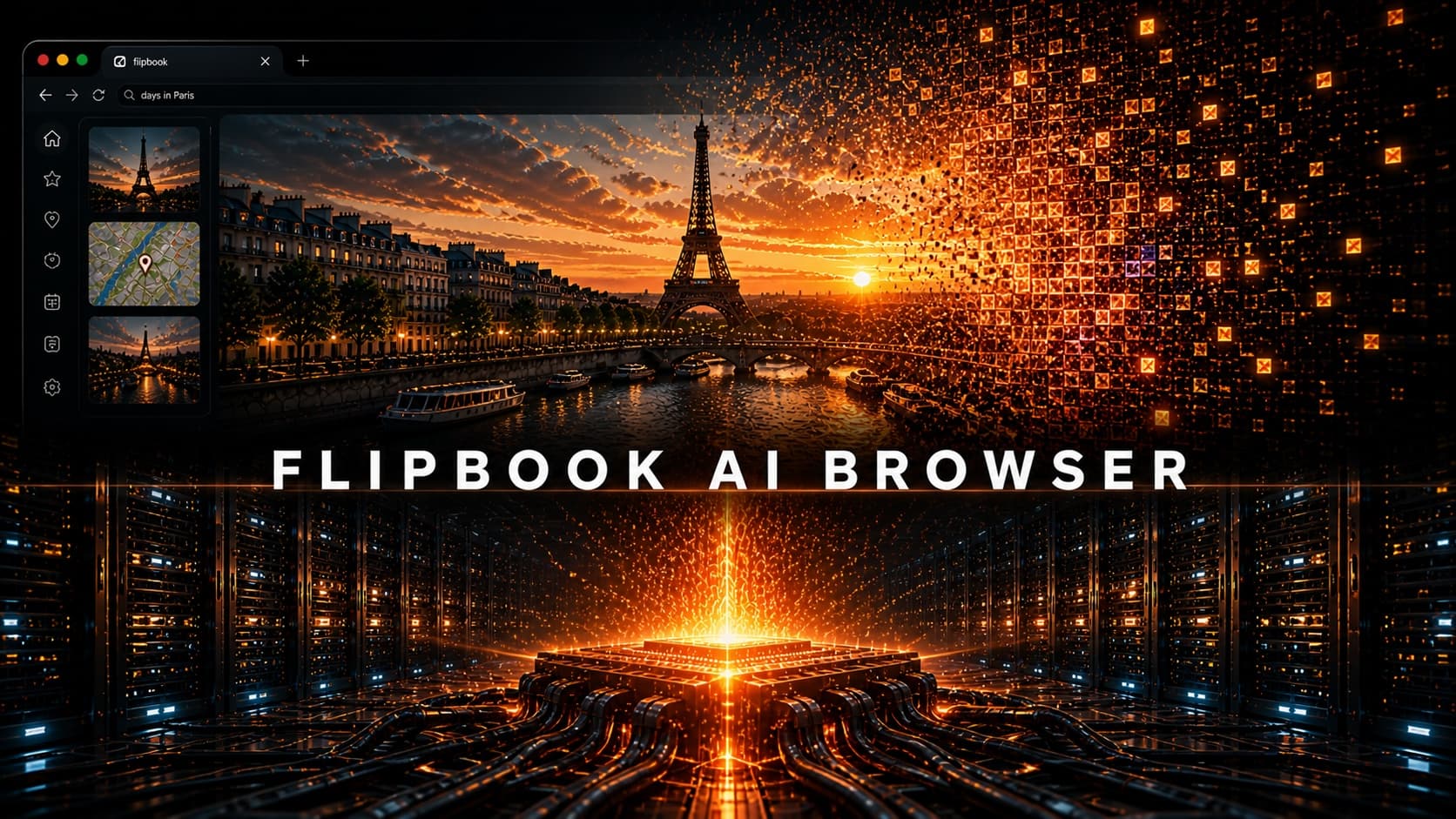
It is an AI browser where every page is rendered on demand by a model. No HTML. No CSS. No layout engine. Even the text is rendered as pixels inside an AI-generated image. Click anywhere, and the next scene is drawn live.
So when something this category-shifting hits the timeline, the question is not whether it is beautiful. The question is who pays the compute bill, and who gets rich while it gets paid.
Let’s look at the trends through a Math Man lens.
What is Flipbook?
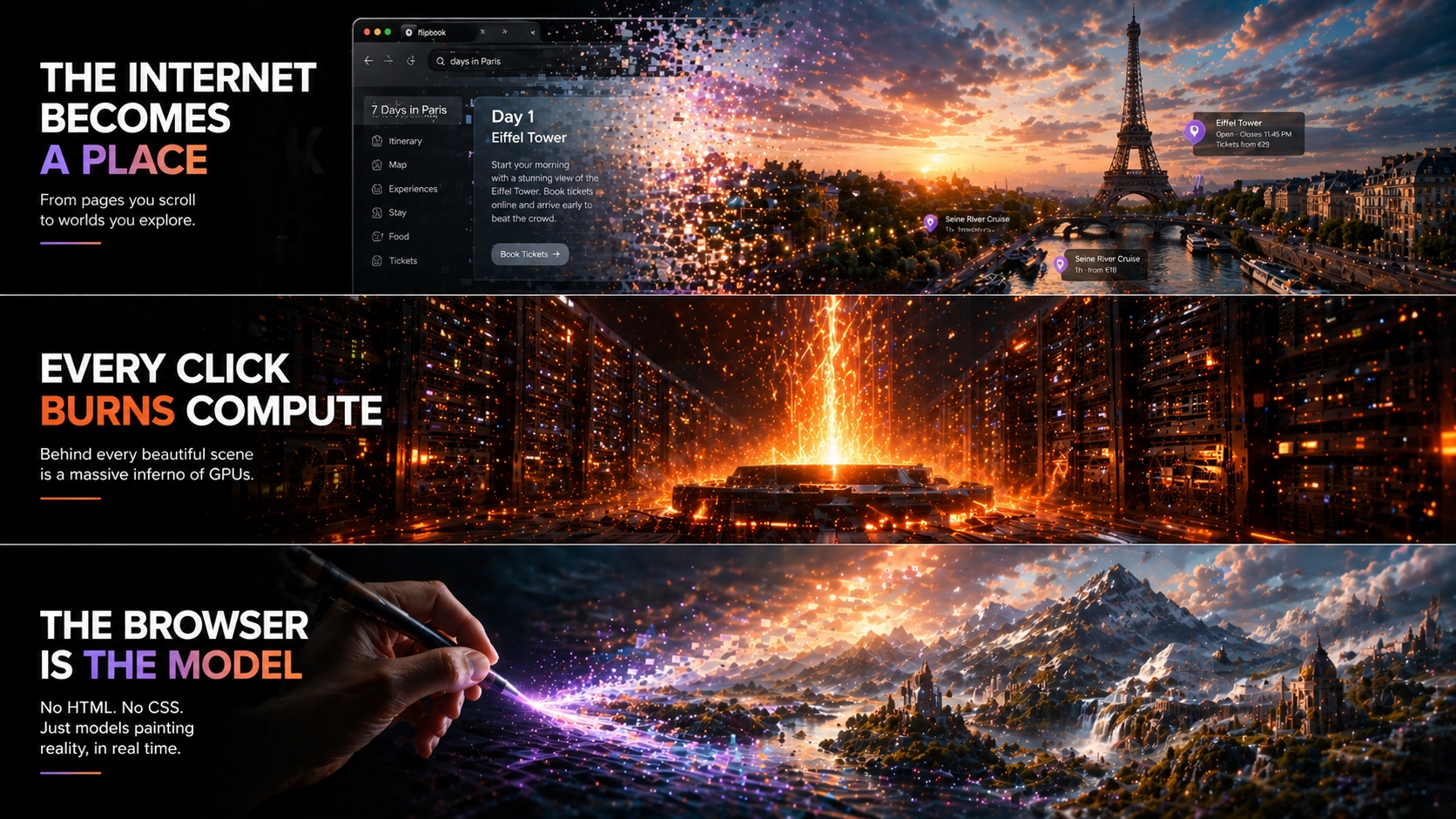
Flipbook is the AI browser that paints. Beta access is open right now, no waitlist, and free. Type a prompt, click anywhere on the generated page, and explore the next scene as it paints itself live in real time (render engine). There is no HTML, no CSS, no traditional layout engine.
Type “7 days in Paris,” and the model paints an illustrated itinerary. Click the Eiffel Tower, and the next page is drawn fresh. Tickets, hours, routes, booking paths.
The backend runs on Modal Labs serverless GPUs. The video mode streams via Lightricks’ LTX, an AI video model that pushes 1080p at 24 frames per second over WebSocket.
This is not a redesign. This is a different machine pretending to be a browser. Find all relevant links below!
Where does Flipbook land in the browser market?
Before we judge what a flipbook is, let's look at what it is. The browser market is one of the most concentrated spaces in tech. Chrome holds 65% to 70% global share and feeds Google's $294 billion 2025 advertising machine.
Safari sits at roughly 18% and earns Apple about $20 billion a year from Google for default-search placement.
Edge holds 5% market share, bundled into Windows, with analyst estimates of $12 to $15 billion in Bing revenue flowing through it.
Firefox sits at 2-3%. Brave, the only major browser running a clean paid model, just crossed 100 million monthly active users and $100 million in annualized revenue in 2025.
Roughly 6 billion users sit inside this stack. Well over $300 billion in annual ad and licensing flow runs through it. Flipbook does not fight Chrome on Chrome’s turf. It bets the next browser war is fought on a different surface, where the AI paints the page.
From database to landscape: the AI browser shift
The old web treated knowledge as a database. You queried, and it returned. Flipbook treats knowledge as a landscape. You wander, it paints. A database serves what it has. A landscape generates what you need, the moment you need it. Nothing is stored, nothing is cached, nothing is the same twice. The page dissolves the second you click away.
That sounds like a metaphor. It is an architecture.
This is AI-rendered browsing, and it inverts a 30-year contract. The web used to be a library you walked through. Flipbook is a library that builds itself around your footsteps and disappears behind you.
That is the elegant version. Now the bill.
Why is the Flipbook AI browser so expensive to run?
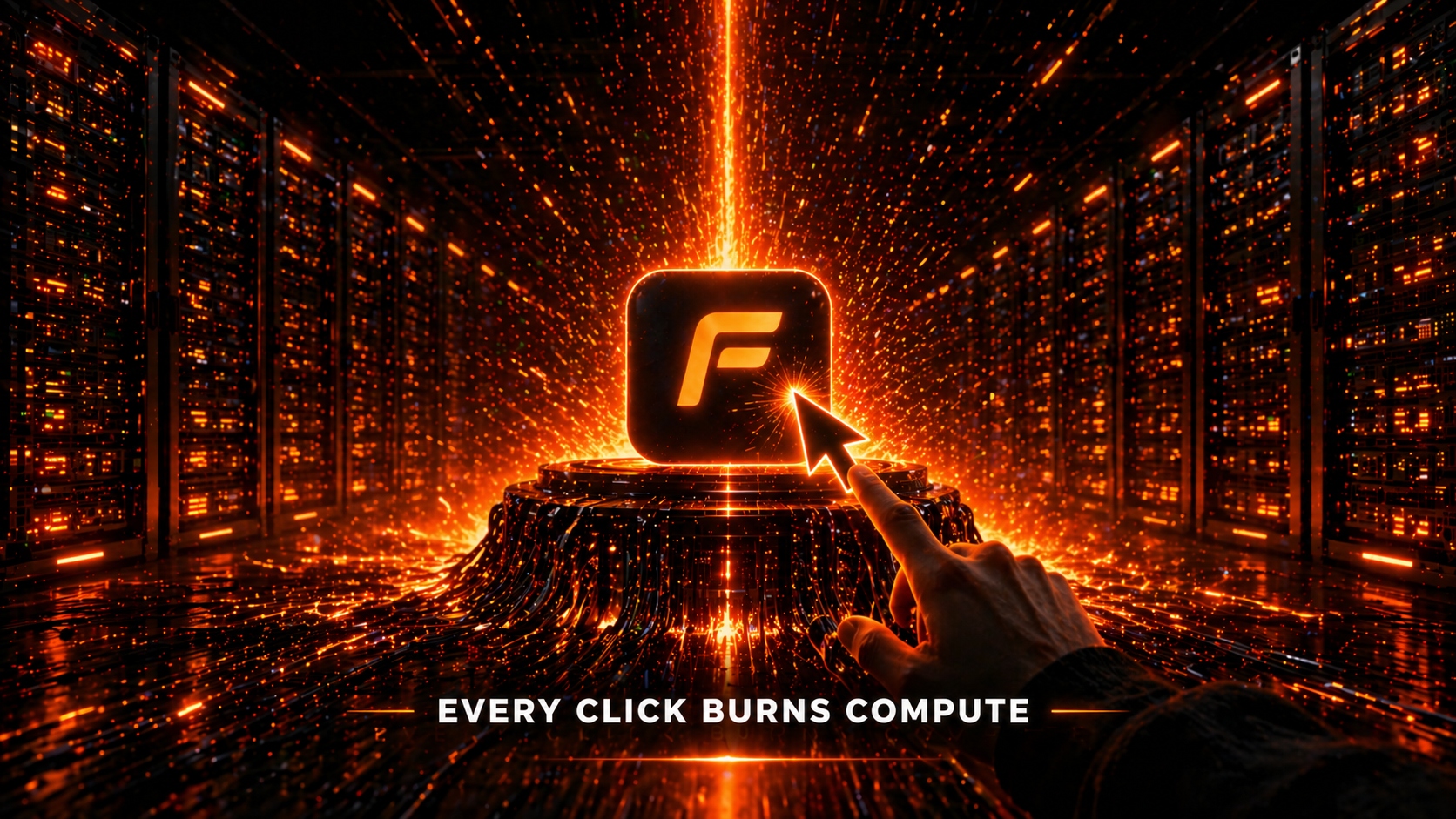
Every Flipbook click triggers a full AI inference stack. Inference means the model computes the answer from scratch on every click, rather than pulling prebuilt HTML from a server.
The stack: reasoning to interpret intent, retrieval to ground the scene, image generation to render it, memory across clicks, and in video mode 24 frames per second of pixel synthesis. A traditional browser pulls cached HTML. Flipbook builds a fresh painting every time you blink.
The cost asymmetry is brutal. Inference now eats 55% of all AI infrastructure spending, up from 33% in 2023. In April 2026, an NVIDIA executive admitted on the record that "the cost of compute is far beyond the costs of the employees," a quiet confession from inside the kingdom.
Stanford's 2025 AI Index reported a 280-fold collapse in cost per token between November 2022 and October 2024. That sounds like good news. It is not, if your product generates a fresh image per click for millions of users. Cheaper tokens just mean more tokens get burned.
Nobody has published Flipbook's unit economics. Nobody will. The answer would scare investors before the product finds product-market fit.
Who profits from the AI compute burn?
The winners are not the app makers. They are the picks and shovels. NVIDIA (H100, H200, Blackwell GB200) sits at the center of inference. Micron, SK Hynix, and Samsung supply the HBM3e memory that every inference GPU depends on.
Hyperscalers (AWS, Azure, Google Cloud, CoreWeave) take the GPU rental slice. Frontier Labs sells the model APIs. The visible app maker takes the smallest cut and carries the largest burn rate.
NVIDIA is the headline trade. Every Flipbook click is an NVIDIA click, until it is not.
Here is the honest part. Google TPUs are eating into the inference workload. Midjourney cut monthly inference costs from $2.1 million to $700,000, a 65% reduction, by switching from NVIDIA GPUs to TPU v6e in 2025.
Anthropic signed for up to 1 million Google TPUs in October 2025 and added a 3.5-gigawatt next-gen TPU expansion in 2026, both coming online by 2027. Meta entered multibillion-dollar TPU talks.
The “NVIDIA gets all the money” trade is real for now, but the inference layer is becoming a fight rather than a monopoly.
Micron is the cleaner play. HBM3e memory is the bottleneck for every modern inference GPU. H200 ships with 141GB of it. Blackwell needs more.
AI inference workloads are memory-bandwidth pigs, not compute pigs, and Micron, SK Hynix, and Samsung supply that memory.
If the browser becomes a screen drawn by a model, the memory makers eat first.
Where this breaks
Flipbook’s biggest weakness is provenance, the proof of where content actually came from. When the model paints the page, the source disappears. There is no link to verify, no citation to chase, no domain to trust or distrust. The page is the model’s interpretation, rendered as truth. Hallucinations move from the text layer to the pixel layer, and people trust pictures more than paragraphs.
That is the provenance problem, and it is bigger than Flipbook.
A misremembered Paris ticket price is a typo in ChatGPT. A misrendered Paris ticket-booking flow on a beautifully illustrated screen is a different problem.
Regulators will move. Schools will hesitate. Publishers will sue.
The aesthetic is gorgeous. The substance is shakier.
My Moonshot Predictions: 5 forecasts on the AI browser economy
As an independent futurist and keynote speaker, I stand out by debunking false prophecies from Big Tech CEOs. Their predictions are often market manipulations, aka pushing their stock prices.
My PAR (Prediction Accuracy Rate) is 84%, compared with Morgan Stanley’s 46% and Ray Kurzweil’s 86%. I do many second opinions on forecasting because I have nothing to push or to sell.
Here are 5 forecasts on Flipbook, the AI browser shift, and the chip plays underneath.
Prediction 1. The AI browser becomes a category by Q4 2026, with at least 3 well-funded clones of Flipbook chasing vertical use cases in travel, education, and enterprise knowledge. Two of them die from compute costs before Q3 2027.
Prediction 2. Micron and SK Hynix outperform Nvidia on a 12-month risk-adjusted basis as the inference layer fragments across Nvidia, Google TPU, and custom silicon, while HBM demand stays universal across all of them.
Prediction 3. The first major Flipbook-style trust scandal lands in 2027, when a generated visual page misrepresents a regulated topic, medical, financial, or legal, and a regulator forces provenance metadata on every generated scene. The W3C and the EU AI Office move first.
Prediction 4. The unit of the internet shifts from the page to the scene over the next 36 months. Anyone still optimizing for SEO without optimizing for AI citation and AI browser placement is building for a web that is already disappearing.
Prediction 5. NVIDIA and Micron book the first wave of AI browser revenue. The picks-and-shovels trade always wins the gold rush, and this rush has just opened.
Will NVIDIA or Google TPUs win the inference market?
Both for different workloads. NVIDIA keeps the frontier training and high-margin inference. Google TPUs are taking volume inference, with Anthropic signing for up to 1 million TPUs in October 2025 and a 3.5-gigawatt expansion in 2026.
The inference layer is becoming a fight rather than a monopoly. The memory makers, Micron and SK Hynix, profit either way.
Final thoughts
Flipbook is not a browser. It is a beautiful furnace with a search bar bolted to the front.
The product is real. The innovation is real. The compute bill is also real, and somebody is going to pay it.
The browser becomes a token furnace. The chips become the new oil rigs. And the Math Man is watching the meter.
Soon, I will publish a follow-up about the browser war and the industry. Subscribe to my free, uncensored email to be the first to know.
Related Links
From us:
Keynote snippet Real Estate Tokenization, Riyadh, Saudi Arabia
Invisible Infrastructures of the Future, Newsletter
AI Disrupting Marketing & Media, Newsletter
From our Secret Vault:
Explore the Flipbook AI Visual Browser: Flipbook.
Fast Company on Flipbook’s interface philosophy: fastcompany.com
Stanford AI Index 2025 on inference cost collapse: aiindex.stanford.edu
Unlock 3,000 handpicked bookmarks in our Secret Vault.
Access My Uncensored Voice of Reason

We all know that the MSM is full of propaganda and biased/bribed journalism. How about Big Tech with content censoring, fake fact-checkers, and fading social channels to black?
Join 55K+ fellow misfits in my uncensored, free monthly newsletter.
Join our WhatsApp for your daily dose of truths and trends.
Turn our Secret Vault into your secret weapon. Unlock 3,000+ links, reports, stories, curated by my team and me. Your unfair advantage to wealth and freedom.
About the Author
In the spotlights, Igor Beuker is a top marketing innovation keynote speaker and futurist known for his foresight on trends and technologies that impact business, economy, and society. Behind the scenes, a serial entrepreneur with 5 exits and an angel investor in 24 social startups. Board member at next-level media firms, changemaker at Rolling Stone Culture Council, Hollywood sci-fi think tank pioneer, award-winning marketing strategist for Amazon, L’Oréal, Nike, and a seer for Fortune 500s, cities, and countries.
Foresight is better shared. Pass it on.