Musk vs. Netflix: Culture Wars, Cancel Calls—The Price of “Woke”
Elon Musk's Cancel Netflix blast lit up X and rattled the stock. The real game behind the outrage, and who wins when culture becomes a balance-sheet line.
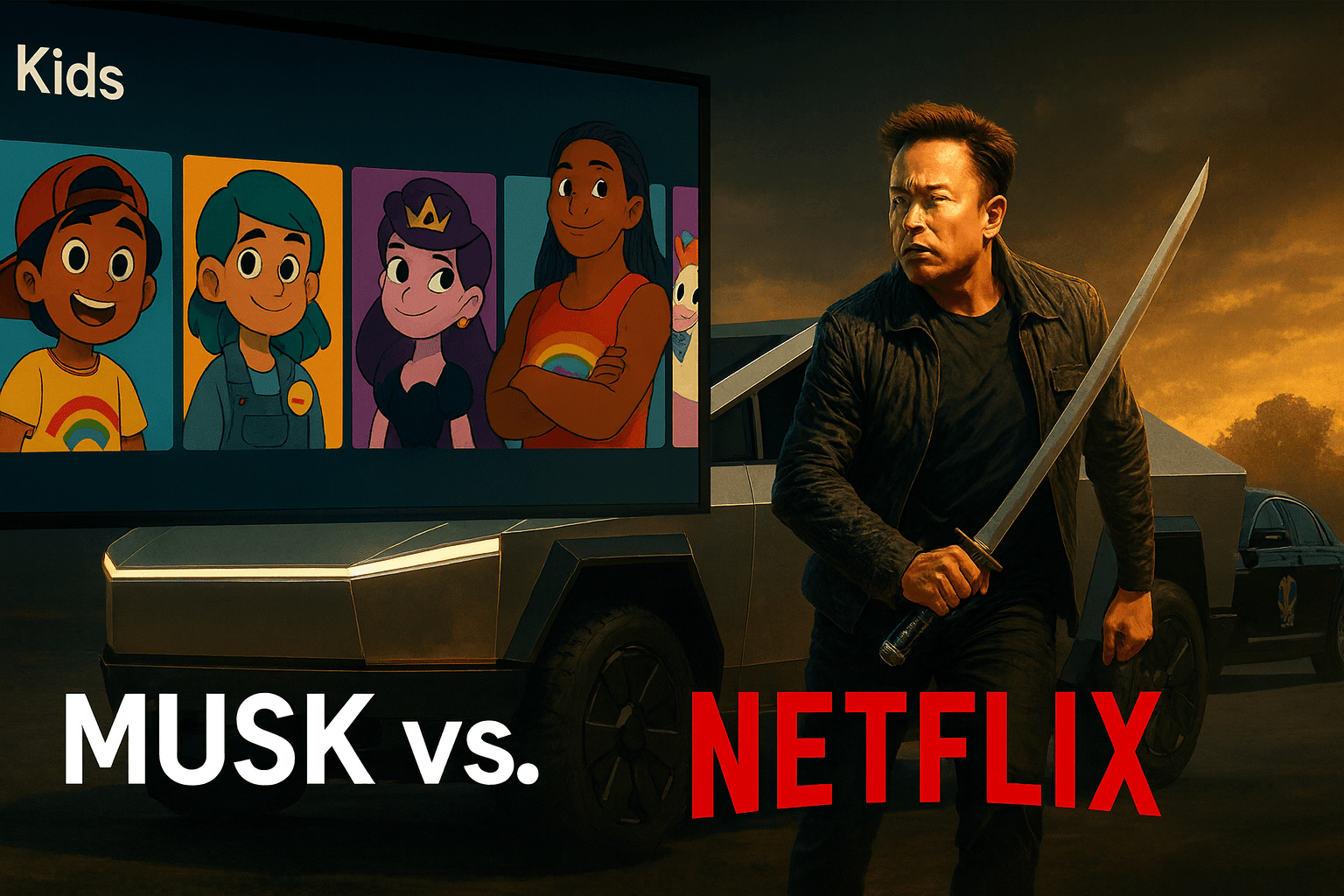
Netflix recently lost roughly $15–$25 billion in market value in about three trading days because one man said two words: “Cancel Netflix.”
On October 1, 2025, Elon Musk made that call to his 227 million followers on X, and the outrage machine took over, trending on feeds, sparking boycott hashtags, and Netflix experienced its most significant weekly drop since April.
This is not a programming spat; it is a power test between a platform owner and a global streamer. And Musk says exactly why he is angry: he blames Netflix for pushing manipulative LGBTQ/trans messages to kids.
Do you feel Musk is right? Do you agree these are again, sneaky ways of predictive programming and social engineering, so he cast the boycott as protecting children?
Why Musk Attacks Netflix: He Swore To Destroy The “Woke Mind Virus”
Musk is not pointing at a single show; he is alleging a pattern in Netflix’s kids catalog. In Musk's framing, it crosses from storytelling into engineering tomorrow’s norm for minors.
He packaged his call as “for the health of your kids” and has repeatedly vowed to “destroy the woke mind virus.”
He has also tied this stance to a personal family experience, an estrangement from one of his adult children, a transgender daughter, which he cites as hardening his resolve.
Agree or disagree with the premise, that is the motive he’s signaling: stop what he sees as ideological pipelines aimed at children, using public opinion and market pressure as levers.
Congressional Heat: Congress Asks Questions
A U.S. lawmaker has said he is preparing to call Netflix executives to testify about allegedly sexualized content aimed at children.
That is not a formally scheduled hearing yet. Still, the threat alone extends the news cycle, pushes brand-safety questions onto advertisers, and raises the odds Netflix opts for quiet, product-level adjustments, more transparent labels, stronger placement in kids profiles, stricter parental-control defaults, over manifesto-style statements that would only amplify the fire. Link below.
Elon Musk Told Disney and CEO Bob Iger To “Go F*** Yourselves”
https://youtu.be/RK91Ji6GCZ8
“Go woke, go broke” isn’t just a slogan; it has case studies to back it up. Bud Light’s collaboration with Dylan Mulvaney did not just spark a week of headlines; it bled into months of sales and share loss: easy substitutes one shelf over, outrage that sustains, and behavior that changes at the point of purchase.
Target’s 2023 Pride backlash reveals a different trajectory: sustained noise, merchandising reversals in parts of the U.S., a tangible drag on traffic and sales for a period, followed by gradual normalization as the cycle progresses.
Jaguar’s “woke” repositioning drew criticism from the culture war and backlash to its brand narrative. At the same time, the causality of KPIs is debated; it serves as a reminder that identity-led creative can ignite controversy without delivering durable commercial upside.
Remember when Elon Musk told Disney and its CEO Bob Iger to “Go F*** Yourselves”? It was during The New York Times’ DealBook Summit 2023.
These 4 factors together set the context: boycotts can be a wobble, a medium-term drag, or a multi-quarter wound, depending on substitutes, duration, and whether the controversy affects core use cases.
I have warned boardrooms for years: media is infrastructure. Whoever controls the pipes of attention controls the terms of debate, and the cash flows that follow.
Musk is not just trolling a streamer; he is asserting platform power. Netflix is not just “content”; it is a cultural switch that flips on in 190 countries at once. When power meets power, sparks fly.
And Musk has said the quiet part out loud. “Cancel Netflix for the health of your kids” was not framed as a consumer annoyance; it was cast as a moral imperative.
Coupled with his “woke mind virus” language, the clash moves from programming to a values referendum, which is why the meme morphed into market movement: shares wobbled, headlines compounded, search spiked, and rival platforms
piled on.
Netflix’s most effective response has historically been operational, not ideological. The company navigated the David Chappelle storms, the password crackdown, and macro headwinds by staying disciplined: let the slate, price ladder, ad tier, and churn math do the talking, while quietly refining the product surface where families actually feel it.
Expect the same posture here: fewer speeches, more visible control of tiles, labels, and defaults.
The Saudi Arabia Angle: Money, Media, Morals, and Leverage
https://youtu.be/yrj4VpQ_PG4
The above keynote highlight is from the Global Leadership Summit in Riyadh, Saudi Arabia. During my talk, I presented my vision for the future of wealth transferring from the Woke West to the East. Since I am 100% independent, I can speak truth to power.
The boycott call spread to Gulf feeds and received amplification from regional business and media accounts. The bigger strategic point is capital. Saudi Arabia’s deal posture in attention and IP is not theoretical: PIF, Silver Lake, and Affinity Partners just offered about $55 billion to take Electronic Arts (EA) private.
That proves they have both the appetite and the resources to bankroll distribution-plus-content ecosystems at scale.
It does not mean a “new Netflix” will appear tomorrow. Still, it does mean the money and deal-making muscle exist to assemble a fast-rising rival stack, FAST channels, rights bundles, creator networks, and curated streaming experiences, if the opportunity looks ripe.
My Take (Actionable Moves)
This skirmish will not dethrone Netflix, but it serves as a live stress test of culture-risk management, and the tape reveals it this week.
Treat sentiment shocks like a modeled risk factor. Tighten brand-safety guardrails where parents notice them, publish a quiet changelog that demonstrates control, and let a timely slate moment recenter the conversation on value. No grandstanding, no victory laps, ship the fixes, then let the numbers and the catalog take back the microphone.
My personal stand on brands that manipulate kids or adults, who lie about vaccines or our food? They should go bankrupt as soon as possible.
Brands should lead by example, embodying strong morals and values, and partner with great social influencers and cause artists.
Bottom Line & Conclusion
Musk moved the tape; Netflix moved the needle. A two-word blast to 227 million followers erased roughly $15–$25B inside a narrow window, a sentiment shock, not yet a strategy break.
Bud-Light-style damage happens when outrage sustains long enough to show up in hard KPIs and substitutes sit on one shelf over. Streaming is not beer: switching is costlier, catalogs are differentiated, and Netflix’s global scale is a shock absorber.
If churn, ad-tier RPMs, or guidance crack, this stops being a wobble and becomes a drawdown. If they don’t, the price action should mean-revert as product and slate retake the narrative.
Related Links
From us:
This blog post I wrote has already garnered over 5 million views. In it, I write about woke marketing and BlackRock forcing behaviors. Read it here: How Do ESG & DEI Force Woke Marketing On Fortune 500s?
Keynote highlight: Role models - Kim vs. Malala.
From others:
EA IR: EA to be acquired by PIF/Silver Lake/Affinity for $55B.
Deadline: Musk backs Rep. Burchett’s move to question Netflix in Congress.
Get Access To My Uncensored Voice of Reason
We all know that the MSM is full of propaganda and bribed journalism. Big Tech makes it even worse with its content censoring, fake fact-checkers, and fading social channels to black.
Should I add how toxic social media platforms push fans on lease, walled gardens, and squeeze artists like lemons?
More marketing innovation strategies in my uncensored, free monthly newsletter.
Join our WhatsApp for your daily dose of truths and trends.
Turn our Secret Vault into your secret weapon.
About the Author
In the spotlights, Igor Beuker is a top marketing innovation keynote speaker and futurist known for his foresight on trends and technologies that impact business, economy, and society. Behind the scenes, a serial entrepreneur with 5 exits and an angel investor in 24 social startups. Board member at next-level media firms, changemaker at Rolling Stone Culture Council, Hollywood sci-fi think tank pioneer, award-winning marketing strategist for Amazon, L’Oréal, Nike, and a seer for Fortune 500s, cities, and countries.
Foresight is better shared. Pass it on.