Holograms.
Are digital avatars holograms?
No. The avatar is the digital person. A hologram is 1 possible way to show it. A digital avatar can be a photorealistic copy of you, an AI presenter, a virtual influencer or a game character. A digital twin is broader: it stands for a real person, object or system and can be wired to real-world data.
Igor's predictions on Holograms
Questions about Holograms, answered
When will Star Wars holograms arrive?
Not at mass-market scale by 2030. Today, light-field displays (Looking Glass, the US maker of glasses-free 3D screens) already show convincing 3D images to several viewers at once. Digital holography is real business in microscopy, medical imaging, industrial inspection, telepresence and displays. Healthcare is its biggest customer, not the concert stage. But Hollywood set a much harder bar: a life-size person floating in open air, visible from every angle, no glasses, no screen, no projector trick. That stays hard because the system must control huge amounts of light and data in 3D space while becoming bright, safe, affordable and mass-producible. An avatar on a stage is not that. A digital twin on a screen is not that either. The numbers agree. Grand View Research puts digital holography at $5.7 billion in 2026 and $23.5 billion by 2033, growing 22.3% a year: about $12.8 billion by 2030. Other houses land between $10.1 billion and $18.7 billion for 2030. A niche, next to the $270.6 billion avatar market and the $1.07 trillion XR market. My forecast: by 2030 spectacular "holographic" experiences are common in entertainment, retail and telepresence, but most run on light-field displays, transparent screens, AR or projection. Princess Leia (the 1977 Star Wars hologram) floating in your room with no glasses? Still a lab demo in 2030. The future looks holographic long before it becomes holography.
Full answer →Are digital avatars holograms?
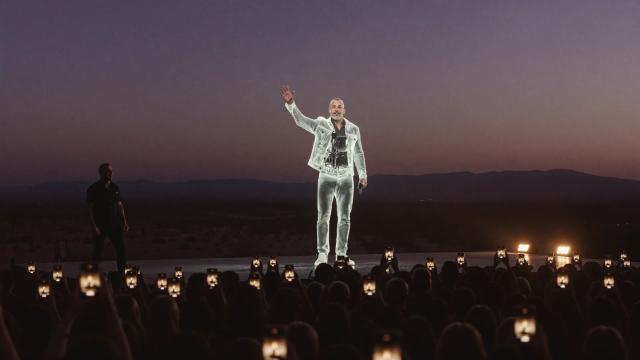
No. The avatar is the digital person. A hologram is 1 possible way to show it. A digital avatar can be a photorealistic copy of you, an AI presenter, a virtual influencer or a game character. A digital twin is broader: it stands for a real person, object or system and can be wired to real-world data. Not every digital twin even has a face. The money says why this matters. Grand View Research values digital avatars at $18.2 billion in 2023 and forecasts $270.6 billion by 2030, growing 49.8% a year. The players are already here. NVIDIA ACE (NVIDIA's digital-human toolkit) powers interactive digital humans. HeyGen and Synthesia (AI video studios) make AI presenters and personal avatars. ElevenLabs (the AI voice company) added reusable talking-head avatars in June 2026. I tested it on myself this week. My avatar now stands on a festival stage as the visual on my Holograms 2030 prediction card. It took 1 render. Nobody scanned my face in a studio. My forecast: avatars become far bigger than holograms. Your banker, teacher, salesperson, customer-service agent, influencer and favorite artist all get a digital human. Whether you meet it on a screen, through glasses or inside a holographic display is only the interface.
Full answer →Holograms vs AR, VR and XR: the difference?
Holography records and displays images, while AR, VR and XR are experience technologies. People mix them up every day, and so do the analysts. Augmented reality adds digital information to the real world. Virtual reality replaces your surroundings with a digital world. Mixed reality anchors digital objects inside the physical world. XR, extended reality, is the umbrella over all 3. Spatial computing overlaps with all of them: the computer understands the room around you and lets digital content interact with it. That is why the language is a mess. Tupac (the rapper, shot dead in 1996) at Coachella was a projection illusion. ABBA Voyage uses digital avatars. An AI talking head is a third category. All 3 look "holographic". None of them is holography. My shortcut, after 25 years of sitting in demo rooms: the avatar is the content. AR, VR and XR are the experience. Spatial computing is the environment. Holography is 1 way to capture or display an image, nothing more. My forecast: by 2030 these worlds collide. The word hologram survives because everybody understands it. The technology underneath it gets far more complicated than the word.
Full answer →Will dead stars perform as avatars?
Yes. The business model already exists, even though most "hologram concerts" are not holograms. I saw the turning point myself. Coachella, April 15, 2012. Tupac (the rapper, shot dead in 1996) walked on stage next to Snoop Dogg (rapper, his friend and label mate), nearly 16 years after his death. The technology was Pepper's Ghost, a stage trick from the 1800s. The emotion was brand new. I saw grown men cry. ABBA Voyage proved the economics with living artists. In 2024 it sold 1.06 million tickets and generated $139.4 million in turnover. Pophouse (the Swedish music-rights company behind ABBA Voyage) takes KISS to a purpose-built Las Vegas theater in 2028. That changes entertainment. Artists no longer have to tour. A younger avatar of the artist performs every night. For dead stars, estates can turn music, image and likeness rights into a new show. My forecast: at least 10 permanent ABBA-style avatar residencies worldwide by 2030, $1 billion a year in tickets. Some feature living artists. Others resurrect artists who are gone. Artists are becoming software franchises. They do not get jet lag. What could change this: likeness laws, estates refusing permission, and fans deciding a dead star on stage is creepy, not magical. Coachella says they buy the ticket and cry anyway.
Full answer →