Universal basic income.
Who pays for Universal Basic Income (UBI)?
Nobody, yet. No country runs a Universal Basic Income (UBI). But 3 governments tested the bill, and all 3 handed it to the same person: you. Macau is the casino model. Eligible permanent residents get 10,000 patacas a year, about $1,240, skimmed from gaming taxes: 92.1 billion patacas since 2008, about $11.4 billion.
Igor's predictions on Universal basic income

Questions about Universal basic income, answered
When will Universal Basic Income (UBI) start?
No country pays a full Universal Basic Income (UBI) today. What exists are pilots, dividends, and promises. Alaska has paid a yearly dividend since 1982, $1,000 per eligible resident in 2025 and 2026. Iran paid nearly every citizen about $45 a month from 2010, the biggest non-Western cash program on record. Inflation has eaten most of it since. Neither is the full national UBI I am talking about. The Romans called it bread and circuses 2,000 years ago. A government that pays your rent owns your vote. It is a power problem. The sellers sit in Silicon Valley. The buyers are governments on every continent. Elon Musk calls it universal high income. OpenAI proposed handing 5% of its shares to a US public wealth fund. A US senator wants a one-time 50% stock tax on the biggest AI companies. Futurist Ray Kurzweil, 13 years on Google's payroll and today chief AI officer of a humanoid robot company, says early 2030s. Peter Diamandis wants it deployed by 2028. I am independent. I take no money from anyone, not from Big Tech. I say later. Nobody can say what China, India and the Gulf will decide. Their choice sets the date of the world's first full UBI. My prediction: the first permanent pocket money arrives, Alaska style, in 1 or 2 countries by 2035. A full national UBI does not begin before 2040. And it is not a law of nature. If the people rise and refuse to be paid for their silence, there will be no UBI. Not in 2040, not ever. Digital slavery does not begin with a free check. It begins when the check becomes your only option.
Full answer →Who pays for Universal Basic Income (UBI)?
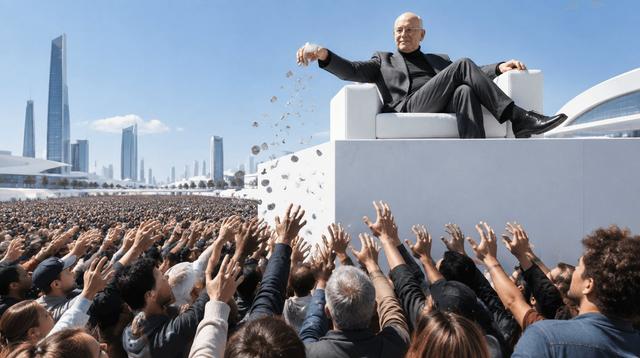
Nobody, yet. No country runs a Universal Basic Income (UBI). But 3 governments tested the bill, and all 3 handed it to the same person: you. Macau is the casino model. Eligible permanent residents get 10,000 patacas a year, about $1,240, skimmed from gaming taxes: 92.1 billion patacas since 2008, about $11.4 billion. Alaska does it with oil. Fine, if you are 700,000 people sitting on a cash machine. 8 billion are not. Iran is the subsidy swap. In 2010 it scrapped fuel and bread subsidies and wired nearly every citizen about $45 a month instead, a third of what a typical Iranian earned. By 2011 those payments ate 6.5% of the economy. Today inflation has chewed them down to pocket change. A cigar from your own box, lit with your own match. Mongolia is the borrowed cigar. From 2010 to 2012 every citizen got about $15 a month from mining money, about 5% of an average monthly wage. In 2012 the fund swallowed 18% of government revenue, part of it borrowed. The handouts died after the 2012 election. The fund died later, 1 trillion tugrik in the red. Silicon Valley is next in line. OpenAI proposed handing 5% of its shares to a US public wealth fund. A US senator wants a one-time 50% stock tax on the biggest AI companies, a $7 trillion pot. Neither is law. Nobody has seen a cent. So who pays? You do. In subsidies you lost, in debt your kids inherit, in pocket money whose value the government sets and inflation erases. The oil, the casino and the machines never pay. They collect. That is the real bill.
Full answer →Will we still work in 2050?
Yes, we still work in 2050, but machines do most of the work we hate. Fewer hours, different jobs, more machine leverage. The prophets say otherwise. Elon Musk says AI and robots make work optional within 10 to 20 years and a universal basic income pays the bills, he calls it universal high income. Sam Altman funded the test: 1,000 Americans got $1,000 a month for 3 years, no strings. Result: they worked 1.3 hours a week less and were more likely to be job-hunting. Employment dipped 2 points. People kept working. That is the only one of the 2 with data, and the data says people keep working. Brilliant builders, not prophets. Each of them sells the robot, the software or the chip that needs you to believe it. The tape today says transformation, not extinction. Amazon passed 1 million robots in 2025, 5 times its 2019 fleet, while its headcount peaked in 2021 and has shrunk since to 1.56 million. McKinsey sold the automation decks, then cuts 10% of its own support staff as AI takes the work. Technology can empower humanity or control it. The only thing that controls technology is us, the people. I choose tech for good. I predicted this 15 years ago: if we imagine the future, robots and AI take over our repetitive, routine, dangerous, dirty and mind-killing jobs. By 2030 that is 30% of routine work, parts of jobs, not whole jobs. What we humans do is hospitality, service and mindful jobs: care, leadership, creativity, relationships, teaching, craftsmanship, judgment, wellbeing. That prediction holds for 2050. A basic income may become part of the safety net. It will not be the reason you stop working. I have no robot to sell and no share price to defend. The future is not humans versus robots. It is deciding which work stays human.
Full answer →