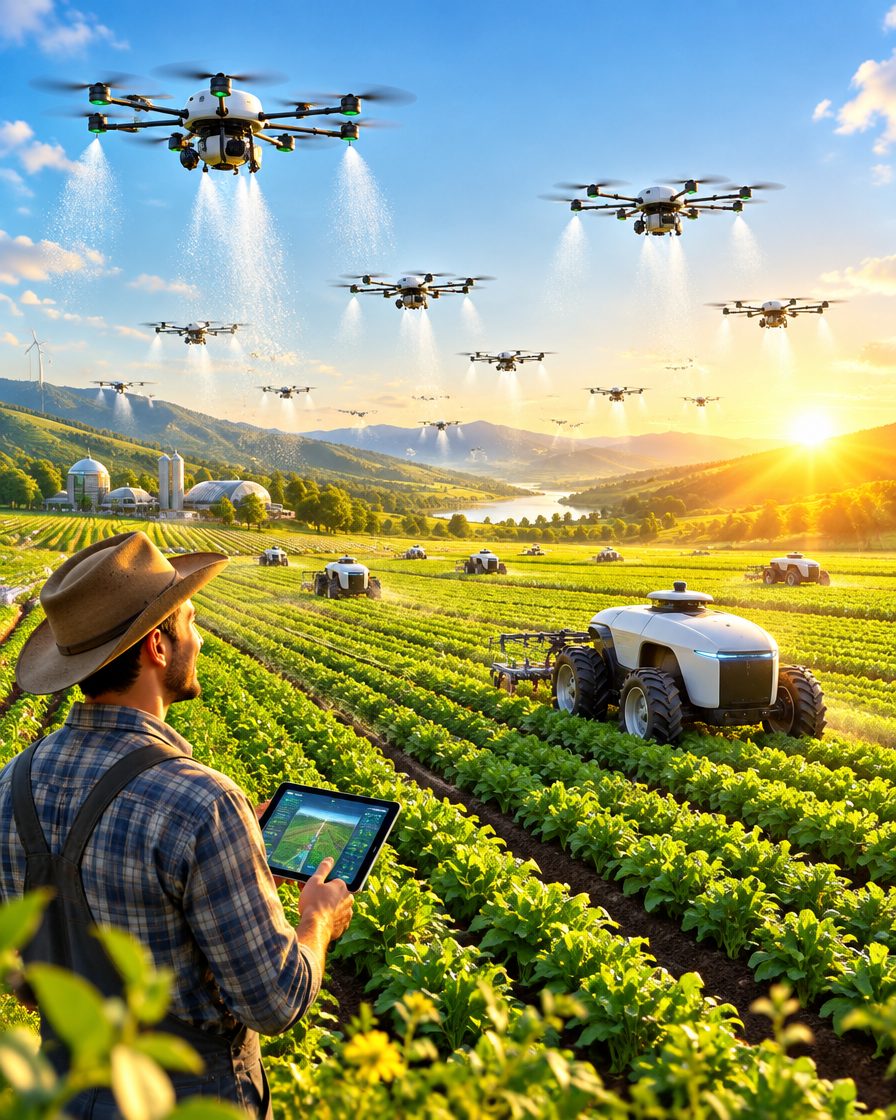
ROBO-FARMS 2030
Robots do 25% of high-tech farm work. The market passes $50 billion.
Key figures
25%: share of repetitive work on high-tech farms done by robots by 2030.
$50 billion+: farm robot market by 2030.
$17.7 billion: agricultural robot market in 2025.
16: cameras on John Deere's autonomous 9RX tractor.
Farm robots are here: self-driving tractors, spray drones, milking robots and AI that sees every plant. John Deere's autonomous 9RX uses 16 cameras.
No farmers, no food: the US has 2.4 million farm jobs to fill every year. Japan's farm ministry sees its workforce shrinking fast toward 2030.
The politics: in 2022 the Netherlands earmarked €24.3 billion for its nitrogen transition, and plans to buy out up to 3,000 farms ignited a farmer revolt. A farmers' party won the 2023 provincial vote. After mass protests, Brussels scrapped its 50% pesticide-cut law in 2024.
Sellers say vs tape: Deere, DJI, CNH and Lely sell autonomy. The top forecast says $56 billion by 2030, the median $41 billion. Monarch Tractor raised about $240 million, was sued over tractors that failed to deliver autonomy, and shut down.
The tape: in 2016 I put drones before 180+ JEM-id clients at its Future Festival. Since then I took AgTech stages in Tanzania and Kenya.
My call: by 2030 robots do 25% of repetitive work on high-tech farms, tractors, spraying, weeding and milking first. Farm robots pass $50 billion. The farmer becomes an AI operator, not a tractor driver.
The warning: control the food chain and you control the people. The future farm needs farmers who own their data and stay in control.
The mission I choose: no oceans, no food either. From Necker Island with Sylvia Earle to Palau, Cabo, Aruba, Curaçao and Bonaire, I fight for coral reefs and against overfishing, drilling and plastic.