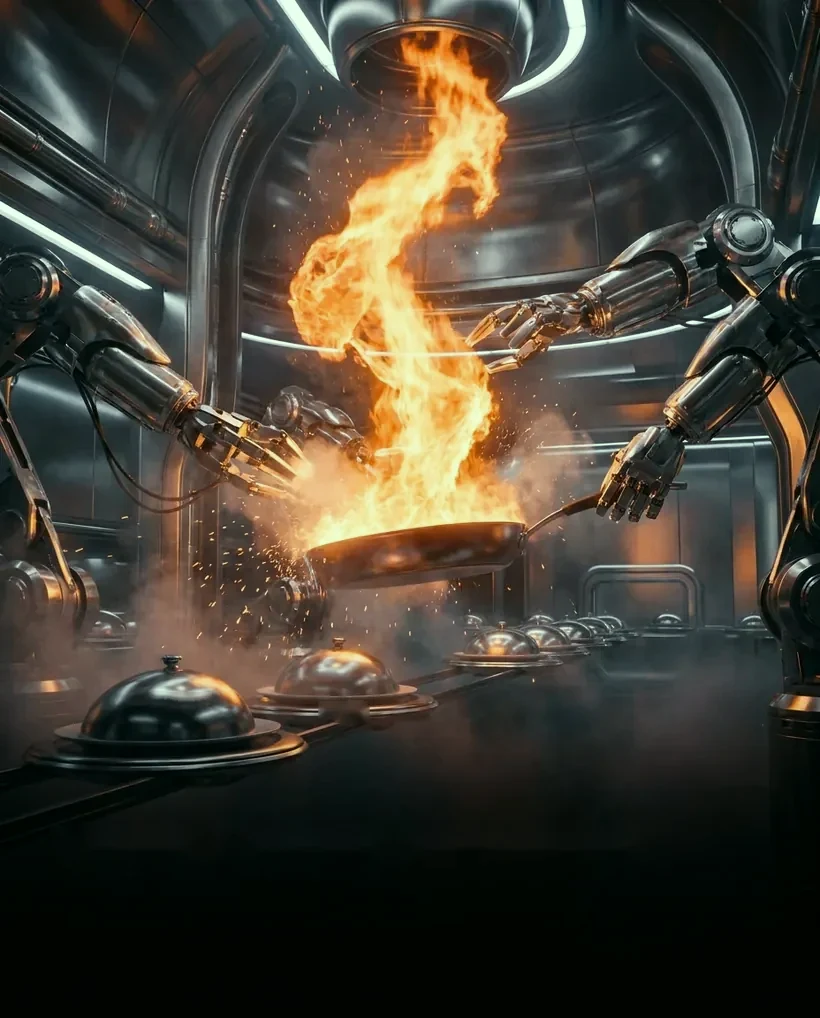
ROBOT KITCHENS 2030
Robots cook 30% of kitchen shifts: 10x faster, 1/8 the cost.
Key figures
Robot-run restaurants worldwide: about 340 today.
Signed western pipelines: 1,500 to 3,000 by 2030, and the biggest one, circus, just slipped a year.
My bull case: 10,000, if Asia matches the West.
A scenario, nobody counts Asia yet.
Speed and cost: the Infinite Kitchen machine makes 500 bowls an hour, a human 45, 10x.
$3 a robot hour versus $26 a human hour, 1/8.
Sweetgreen's robot stores save over 7 points of labor cost and ring up 10% higher tickets.
The money: Wonder $9 billion valuation, $2.7 billion cash burn to 2029, 150 jobs cut this week for robots and an IPO.
Circus SE: 2026 revenue forecast cut from eur 44-55 million to eur 5.2 million.
US restaurants: $1.5 trillion a year, 15.8 million workers, fast food $331 billion of it.
Kitchen robotics: $3 to $5 billion today, consensus $5 to $8 billion by 2030.
My call: robots do 30% of restaurant kitchen work by 2030, fast food first, not 100%.
Robot kitchens are here: machines that chop, fry, assemble, pour and clean, for salads as much as burgers. The Infinite Kitchen machine turns out 500 bowls an hour. A human makes 45.
Why now: the kitchen is the most routine workplace in the service economy. US restaurants pay 15.8 million people on $1.5 trillion of sales, fast food alone $331 billion on 4.1 million workers, and staff are hard to find at $15 an hour, $20 in California. A robot hour costs about $3, a human hour $26.
The players: Marc Lore's Wonder, $9 billion, bought Sweetgreen's Infinite Kitchen, Grubhub and Blue Apron, and cut 150 jobs this week to fund robots and an IPO. Sweetgreen runs 35 robot makelines. Chipotle and White Castle run robots. Circus SE in Munich promised the first fully robotic chain, 500 kebab robots for Mangal, up to 2,400.
Sellers say fully automated by 2030. Sweetgreen says its robot stores save over 7 points of labor cost and ring up 10% higher tickets. The tape: Sweetgreen once planned robot kitchens in half of 40 new stores a year, now nearly half of 15, with sales falling for 2 years. Circus cut its 2026 revenue forecast by 90% in July, pushed the rollout to 2027 and now feeds the Ukrainian army. About 340 robot-run restaurants exist worldwide. Wonder's own deck burns $2.7 billion by 2029. Zume already died.
My call: by 2030 robots do 30% of the work in restaurant kitchens, fast food first, because it is the most repetitive. That is work, not restaurants: signed pipelines point to 1,500 to 3,000 robot-run restaurants by 2030, my bull case 10,000 if Asia matches the West. People keep the counter, the fixes and the menu. My 15-year-old call: parts of jobs, not whole jobs.
The warning: the robot lowers the cost, not the quality, and the savings go to the owner, not the plate. The worker loses the first job on the ladder. And whatever it cooks, salad or burger, the machine does not change the recipe. That stays a human choice.