Elon Musk Launches Tesla Terafab. Should ASML Be Worried?
Elon Musk launches the Tesla Terafab Project on March 21. A $25 billion chip factory with zero semiconductor experience. Should ASML be worried? Jensen Huang calls matching TSMC virtually impossible. Samsung just signed a $16.5 billion deal to keep making Tesla chips through 2033. Igor Beuker maps what is real, what is not, and what it means for the future of AI silicon.
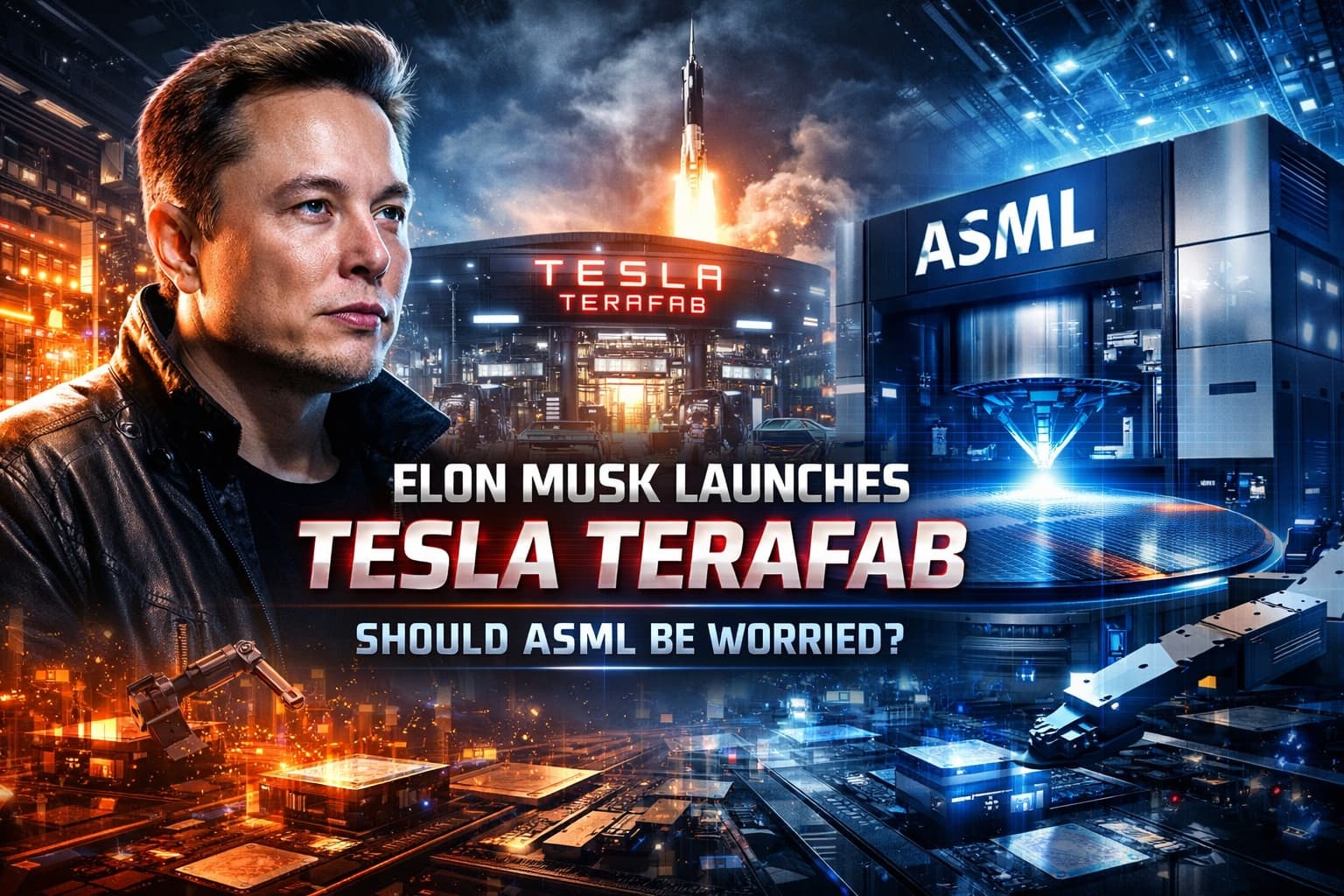
Have you seen the Tesla Terafab frenzy on X? Elon Musk wants to build the world's largest chip factory from scratch, shaking up ASML, with zero semiconductor experience, in 2 years. Has the impossible-is-nothing mindset finally met its match?
We are talking $25 billion, 200 billion chips per year, 2nm technology, and logic, memory, and packaging all under one roof. The launch event is March 21, 2026. That is the confirmed story. Musk said it himself: "We have to build a gigantic chip fab. It's like giga but way bigger."
Word of warning. Your feed might be full of viral posts claiming Tesla will build 1,000 EUV machines per week, outproducing ASML by 520 times. These are not Musk's claims! Not even close. Zero credible sources confirm any of it.
That is the Math Man job: separating signal from noise before the noise separates you from reality.
Will Musk disrupt again? Or is this his most expensive bluff yet?
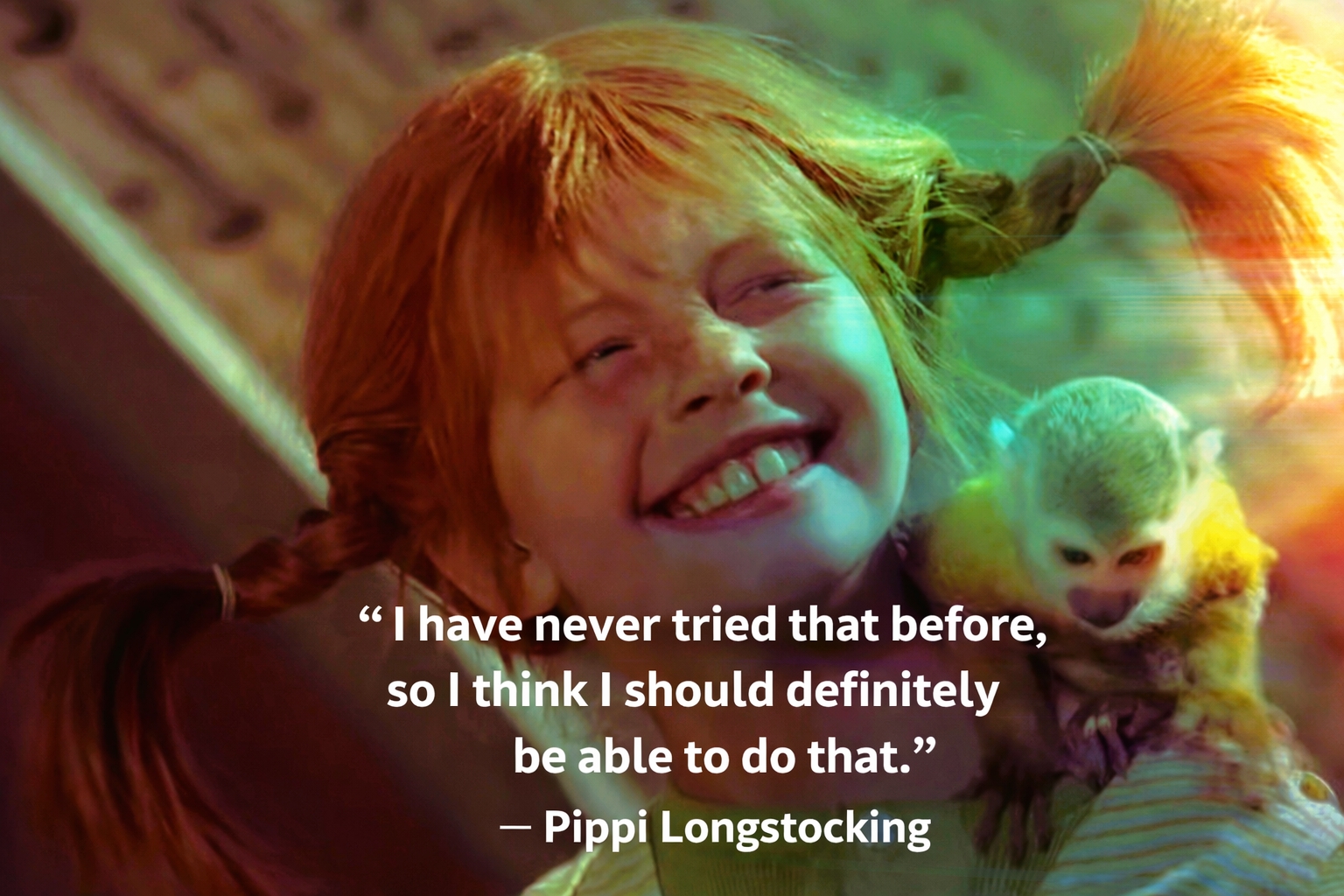
Elon Musk x Pippi Longstocking: The Mindset That Ignores Impossible
I know people love or hate Elon Musk. Let me be crystal clear about his track record. No one on this planet can challenge his vision, his skills, or his results.
I have challenged market-manipulating predictions from Big Tech CEOs, including several from Musk. I am 100% independent. No sponsors. No ads. No collabs. No institutional masters. My prediction accuracy is 84%. Ray Kurzweil hits 86%. Morgan Stanley: 46%.
What I love about Musk's mindset is the same innovative DNA as that of the legendary Pippi Longstocking.
The man who personally re-engineered SpaceX rockets and landed them back on what looked like a floating paper cup in the middle of the ocean. Who said electric cars would outsell combustion engines and was laughed off every stage he walked onto?
His impossible-is-nothing mindset has a track record. A real one.
But semiconductor manufacturing is a different beast entirely. The $25 billion question is whether Musk's genius translates from rockets and batteries to 2nm silicon chips, so small that 2nm is roughly the width of 10 hydrogen atoms stacked side by side.
Can anyone do it? It is Musk.
What Tesla Terafab Actually Is. And Why Every Chip Giant Should Lose Sleep.
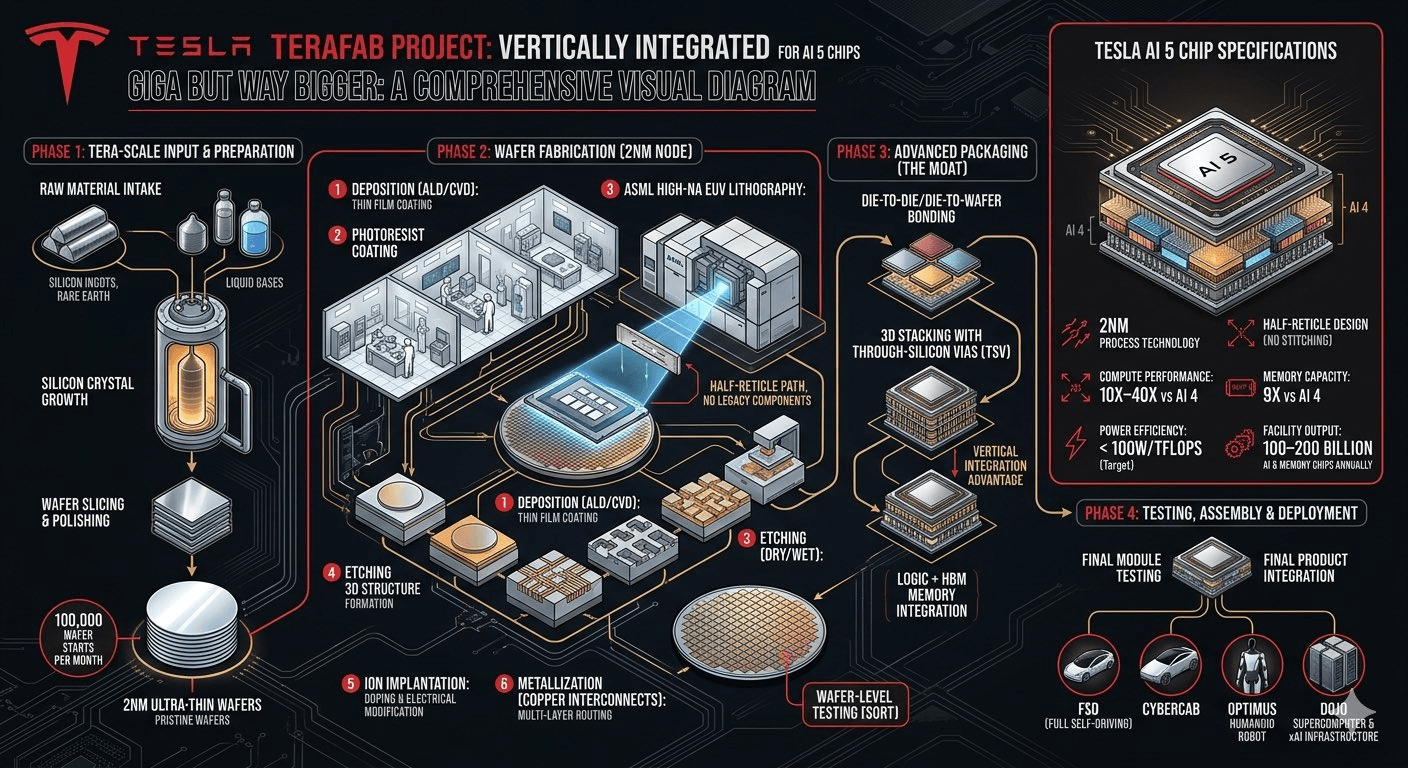
Tesla first confirmed Tesla Terafab on its January 28, 2026, earnings call. Musk told investors the company needs its own chip fabrication facility to avoid a supply constraint he projects will hit within 3 to 4 years. The facility combines logic processing, memory storage, and advanced packaging under one roof.
Something no company, including TSMC (Taiwan Semiconductor Manufacturing Company, the world's largest chip foundry responsible for making chips for Apple, Nvidia, and virtually every major tech company on the planet), currently does at this scale.
"We have to build a gigantic chip fab. Tesla Terafab. A very big fab that includes logic, memory, and packaging, domestically.", Elon Musk, Tesla Q4 Earnings Call, January 28, 2026
The numbers: $25 billion estimated cost. 100,000 wafer starts per month scaling toward 1 million, roughly 70% of TSMC's current total output, from a single US facility. 100 to 200 billion custom AI chips per year.
Powering Tesla's FSD (Full Self-Driving) software, Cybercab robotaxi, Optimus humanoid robots, and xAI's Dojo supercomputer. An AI training infrastructure that rivals Google and Microsoft in scale today.
Tesla's AI5 chip, its 5th-generation artificial intelligence processor, reportedly delivering 40 to 50 times more computing power than its predecessor, is set to begin small-batch production in 2026. Volume production targets 2027.
March 21 is not a factory opening. It is groundbreaking. Semiconductor fabs take 2 to 3 years from ground to first wafers. Nobody seriously expects chips next week.
Zero Experience. $25 Billion. What Could Go Wrong?
Jensen Huang, Nvidia CEO, warned plainly: "Building advanced chip manufacturing is extremely hard. It is not just building the plant, but the engineering, the science, and the artistry of doing what TSMC does for a living is extremely hard." Huang went further, telling reporters that matching TSMC's semiconductor capabilities is "virtually impossible."
Tesla has never manufactured a single chip. Every Tesla processor ever built was outsourced to TSMC and Samsung. Designing chips and manufacturing them are entirely different disciplines.
TSMC spent decades and tens of billions building its process expertise. Intel, with thousands of experienced fab engineers and over $100 billion invested, has spent years struggling to regain its manufacturing edge. Samsung still trails TSMC in yield rates at advanced nodes.
"Crazy fabs are really hard!": Elon Musk, January 2026
The 4680 battery cell is the closest parallel. At Battery Day in September 2020, Musk promised 100 GWh of in-house cell production by 2022, a 56% cost reduction, and a $25,000 Tesla.
By early 2025, five years later, actual output was estimated at roughly 20 GWh. A semiconductor fab is orders of magnitude more complex than a battery cell.
My Forecast: Tesla Terafab: Real Vision, Brutal Timeline
Tesla Terafab is not a bluff. The need is real, and the strategy is right. Tesla's AI ambitions require chip volumes no external supplier can commit to on Musk's timeline. Vertical integration is the strategic smart move.
The timeline is the gamble. My forecast, based on my 84% Prediction Accuracy Rate: Terafab produces its first meaningful output in 2028 at the earliest. Full scale is a 2030 story. Add 2 years to whatever Musk promises. The 4680 lesson applies.
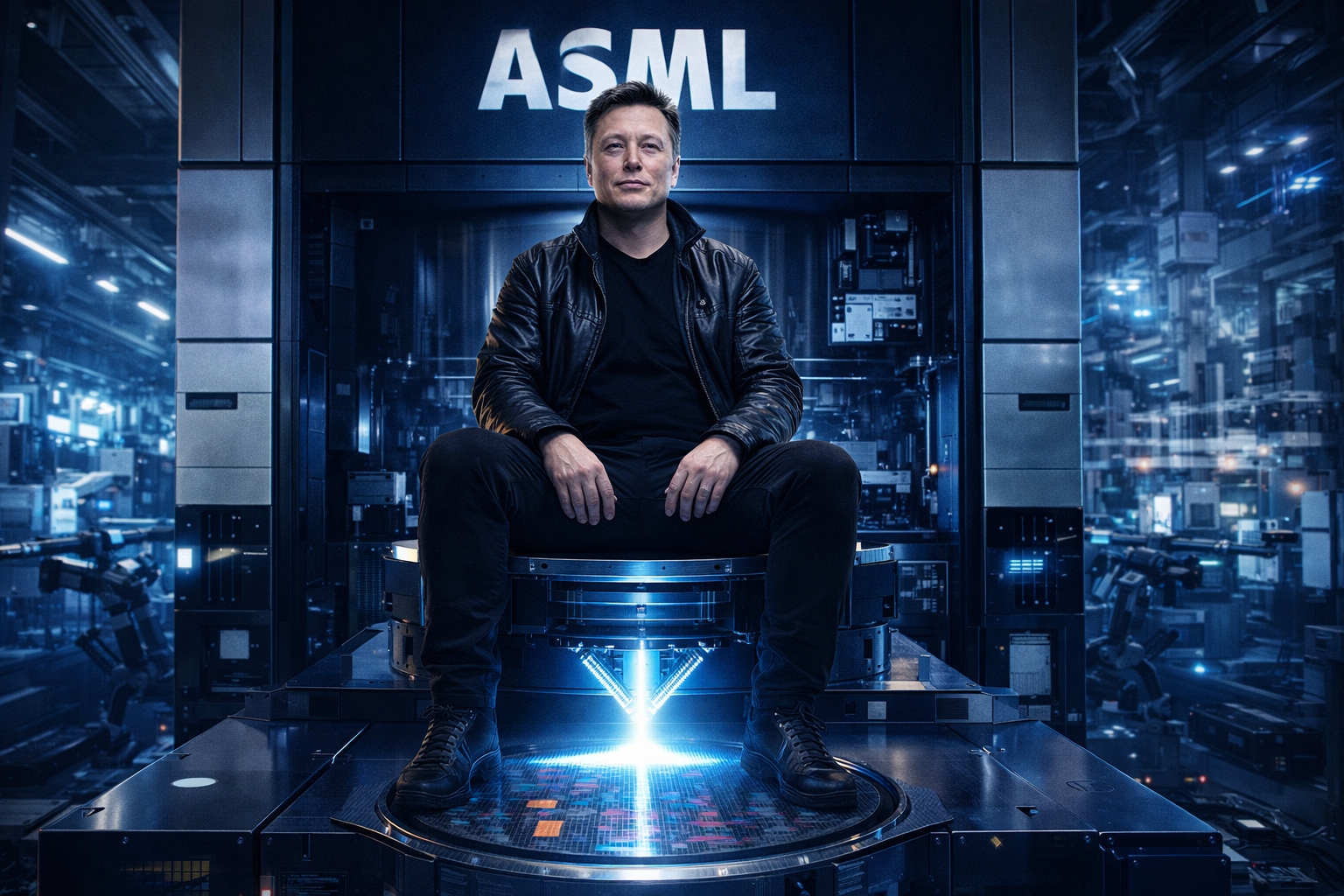
ASML should not be worried. Not yet. Tesla will buy EUV machines from ASML like everyone else. Terafab is a customer story, not a competitor story. If Terafab succeeds, ASML sells more machines. Simple.
The real pressure lands on Micron, SK Hynix, and Samsung. Why?
If Tesla builds its own HBM (High Bandwidth Memory, the ultra-fast memory chips that power every AI system on the planet) production at scale, 3 of the world's largest memory suppliers lose their biggest emerging customer. That is the threat worth watching.
And a reminder for the Mad Men and other linear minds: Musk is already running HBM above our heads right now. It is called SpaceX Starlink.
I bought $500k in SpaceX private equity in 2019. My PAR of 84% comes with a price tag. Soon, I will be able to buy an island and build more bunkers than Big Tech bozos Zuckerberg, Ellison, and Bezos combined.
The Precedent Nobody Is Talking About
Respecting Musk's track record does not mean ignoring his pattern. Or acting like a groupie. And the pattern is clear.
Musk has done this before. In September 2020, he promised 100 GWh of in-house 4680 battery cell production by 2022, a 56% cost reduction, and a $25,000 Tesla. Five years later, actual output was roughly 20 GWh. One-fifth of the target. Still undelivered.
Battery manufacturing is child's play compared to 2nm semiconductor fabrication.
In August 2025, Musk killed the entire Dojo chip project and lost Peter Bannon, the architect in charge of all custom silicon at Tesla. Around 20 chip engineers followed him to a competitor startup. In my view, Tesla is now attempting to build the world's largest 2nm fab with a gutted chip team.
The $25 billion launch number is not the real number. Reaching full Terafab scale could require $1 trillion in capital expenditure over a decade.
And while Tesla Terafab does not yet exist, Samsung just confirmed a $16.5 billion deal to produce Tesla's AI6 chip at its Taylor, Texas fab through 2033. Tesla still fully depends on external suppliers today.
Final Thoughts
On March 14, Elon Musk posted 5 words that moved markets, broke the internet, and spawned a thousand viral posts. Most of them wrong.
A $25 billion bet to manufacture 2nm chips from scratch, with zero semiconductor experience, on a timeline that makes the entire industry nervous. That is extraordinary enough without the fiction.
This is the man who landed rockets on a paper cup. His track record has earned the benefit of the doubt. Not blind faith.
Should ASML be worried? ASML should worry about the day Terafab actually works. Because that is the day every tech giant realizes vertical integration is no longer optional.
Related Links
From us:
- Invisible Infrastructures of the Future | Math Man Magazine | September 2025
- AI Disrupting Marketing and Media | Math Man Magazine | February 2026
- Keynote highlight: Hire the talent for Industry4.0
From our Secret Vault:
- 2026 Global Semiconductor Industry Outlook
- Tesla Terafab chip fab ambitions ignore lack of semiconductor experience
- ASML: The monopoly powering every advanced chip on earth
Access My Uncensored Voice of Reason
We all know that the MSM is full of propaganda and biased/bribed journalism. How about Big Tech with content censoring, fake fact-checkers, and fading social channels to black?
Join 55K+ fellow misfits in my uncensored, free monthly newsletter.
Join our WhatsApp for your daily dose of truths and trends.
Turn our Secret Vault into your secret weapon. Unlock 3,000+ links, reports, stories, curated by my team and me. Your unfair advantage to wealth and freedom.
About the Author
In the spotlights, Igor Beuker is a top marketing innovation keynote speaker and futurist known for his foresight on trends and technologies that impact business, economy, and society. Behind the scenes, a serial entrepreneur with 5 exits and an angel investor in 24 social startups. Board member at next-level media firms, changemaker at Rolling Stone Culture Council, Hollywood sci-fi think tank pioneer, award-winning marketing strategist for Amazon, L’Oréal, Nike, and a seer for Fortune 500s, cities, and countries.
Foresight is better shared. Pass it on.