Who wins and who loses when kitchens go robotic?
The owner wins and the entry-level worker loses. The robot lowers the cost, not the quality, and the savings go to the owner, not the plate. The math: a robot hour costs about $3, a human hour $26. Sweetgreen's robot stores save over 7 points of labor cost. The investors win too. Wonder raised $650 million at a $9 billion valuation in July 2026, and in September cut 150 jobs to fund robots and an IPO. The worker loses the first job on the ladder: by 2030 robots do 30% of the work in restaurant kitchens, fast food first, while people keep the counter, the fixes and the menu. That first job matters. For millions of teenagers, the fry station is where they learn to show up on time. The guest gets speed and the same bowl every time. The Infinite Kitchen machine makes 500 bowls an hour, a human 45. And whatever it cooks, salad or burger, the machine does not change the recipe. That stays a human choice.
3 related prediction cards
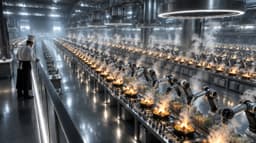 ROBOTS COOK 30% OF KITCHEN SHIFTS: 10X FASTER, 1/8 THE COST.→
 $1.2 TRILLION FAST FOOD: SUPERSIZED PROFITS AND WAISTLINES.→
 AI AND ROBOTS TAKE 30% OF ROUTINE WORK, PARTS OF EVERY JOB.→
Related blogs
 Igor Beuker Headline Keynote Speaker - Deep Tech Atelier Conference Special→
 ChatGPT by OpenAI: Record-Breaking Technology Better Than Google?→
 AI Backlash: Inside Humanity's Revolt Against Big Tech→
Related FAQs
Will robots run restaurant kitchens by 2030?→Why are restaurants switching to robot kitchens?→Do robot kitchens actually work?→How can a restaurant use AI to make more profit?→Did Igor Beuker predict 2.5 billion overweight people?→What is actually in fast food?→Your question not here? Ask Igor. Free for all. Unlimited for members, sign up.
Ask Igor