Solopreneurs.
SOLOPRENEUR NATION: 50% OF THE WORKFORCE. PAYROLL IS DYING.
The employment model is inverting, and HR is the last to know. I forecast that by 2030, 50% of the workforce in major economies is independent. But independent splits in 2: freelancers and solopreneurs. A freelancer sells hours.
Igor's predictions on Solopreneurs

Questions about Solopreneurs, answered
Why do freelancers get squeezed?
Supply explodes while distribution tightens. Organic reach sits around 1%, Google buries small players on page 16, and AI bots answer inside their own window so nobody clicks out to your site. When supply rises and differentiation falls, pricing compresses. That is market mechanics, not opinion.
Full answer →Who loses in the solopreneur economy?
The staffing middlemen, Randstad, Adecco, ManpowerGroup, the friction between talent and work. And every freelancer who sells tasks by the hour, refuses to specialize, and rents reach from algorithms. They compete on price until they lose.
Full answer →Why did the old gig economy stop growing?
Because a human can only sell 24 hours, and the platform owns the customer. 2 reasons. First, the ceiling: a human can only sell 24 hours, and Staffing Industry Analysts measured $3.7 trillion in 2017 and $3.7 trillion in 2023, zero growth in 6 years, even with 154 to 435 million people gigging online. Second, the model: the platform owns the customer and takes its cut. Fiverr keeps a flat 20%, Airbnb 15.5%, Uber 25% and past 50% in some cities. When you sleep, your income sleeps.
Full answer →What is the machine gig economy?
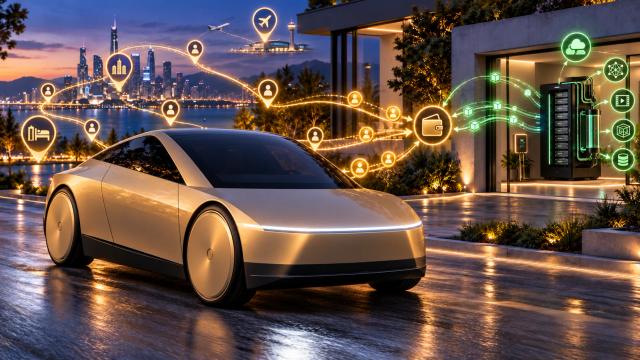
The machine gig economy pays you for your machines, not your hours: robotaxis, home batteries, robots, home computers. The old gig economy sold your hours: Uber your driving, Fiverr your skills, Airbnb your spare room. It stopped growing at $3.7 trillion, the same in 2017 and 2023, because there are only 24 hours in a body. The machine gig economy sells your machines instead: a robotaxi that drives strangers while you sleep, a home battery that sells power at 6pm, a robot that clocks in without you, home compute that rents out its brain overnight. My forecast: owned machines pay out $350 billion a year by 2035 in the base case, $1 trillion in the upside case. Purpose. Passion. Paycheck. Projects. The paycheck just stopped needing your hours.
Full answer →Freelancer or solopreneur: what is the difference?
A freelancer sells hours, while a solopreneur builds a cash-flow machine: systems, IP, recurring revenue, a CRM, and AI leverage. A solo designer with Midjourney outships an agency, a solo developer with Claude Code ships what a 5-person team shipped in 2020. Only 1 of the 2 wins.
Full answer →Can AI agents replace freelancers?
Not yet end to end, and I say so on the card: AI agents finish only a sliver of real freelance projects. But they already ate the entry-level half. The solopreneur owns the audience, a newsletter, a community, a direct line, sells outcomes, thinks like an M&A manager about IP, and uses AI as leverage.
Full answer →Can you make money with a home computer or Nvidia GPU?
Yes, and it is the second machine in my machine gig economy, next to the robotaxi. A home compute box rents out its processing overnight to AI workloads, the same way a home battery sells power back to the grid at 6pm. Tesla's Powerwall programs already pay owners $275 to $1,500 a year. I count home compute, batteries, rooftops, and household robots as the layer that lifts owned-machine income from $228 billion (robotaxis alone) to $350 billion a year by 2035, with $1 trillion as the upside case. Own the machine. Do not rent out your body.
Full answer →I'm 17 to 21. What's the best path to income?
Get really good at 1 skill in a growing industry: AI, robots, energy, space, health, or a technical trade. There is not 1 best path to income. The best path is where your talent, your skills, your passion and your education meet an industry that grows. Take a good look at the growing industries and technologies: AI, robots, drones, energy, space, health. Then make a clever choice where you invest your time: for an employer, as a freelancer, or as a solo entrepreneur. 2 tips. Stay away from routine work: by 2030, AI and robots take 30% of it. And have a good look at technical jobs: electrician, plumber, heating and cooling technician, welder. They are in high demand, they pay well, and no robot fixes a burst pipe any time soon. First things first: you need to make some money before you can invest it. Time is on your side, and patience is a virtue. Use that time to get really good at 1 thing, the income follows.
Full answer →Why did you build the Secret Vault, and who is it for?
I built the Secret Vault to put the future intelligence once reserved for corporations, investors, and wealthy insiders in everyone's hands. You deserve uncensored, honest, truth-seeking news and forecasts from an independent expert, not Big Tech, sponsored, or bribed predictions, so you can boost your freedom and wealth. Live like the 1%. Think like them first. After 25 years of predicting disruption and building companies with 5 exits, I decided to open my research to people who dare to take action. It's for entrepreneurs, founders, investors, freelancers, creators, ambitious employees, and fellow misfits who want to take control of their future, build financial independence, and use their success to make a positive impact.
Full answer →Who owns the robotaxis, people or Tesla?
Today, Tesla. The 45 Cybercabs on Texas roads in September 2026 run on Tesla's own network, not for private owners. That is the warning in my forecast: if Tesla, Waymo, and 3 funds end up owning every earning machine, the new gig economy is feudalism with an app. My advice: people should own the machine, not rent out their body. Entrepreneurs should build the owner side: financing, insurance, and tax for the family with 3 machines. Governments should tax machine income before the last paycheck disappears. Whoever owns the machine owns the future.
Full answer →