Agtech.
Can AgTech help feed 10 billion people?
Yes, by producing more food per liter of water, per hectare, and per hour of labor. It has to help. The world is heading toward nearly 10 billion people by 2050 while agriculture is being squeezed by water shortages, labor shortages, soil degradation, climate volatility and pressure on available farmland.
Igor's predictions on Agtech
Questions about Agtech, answered
Can AgTech help feed 10 billion people?
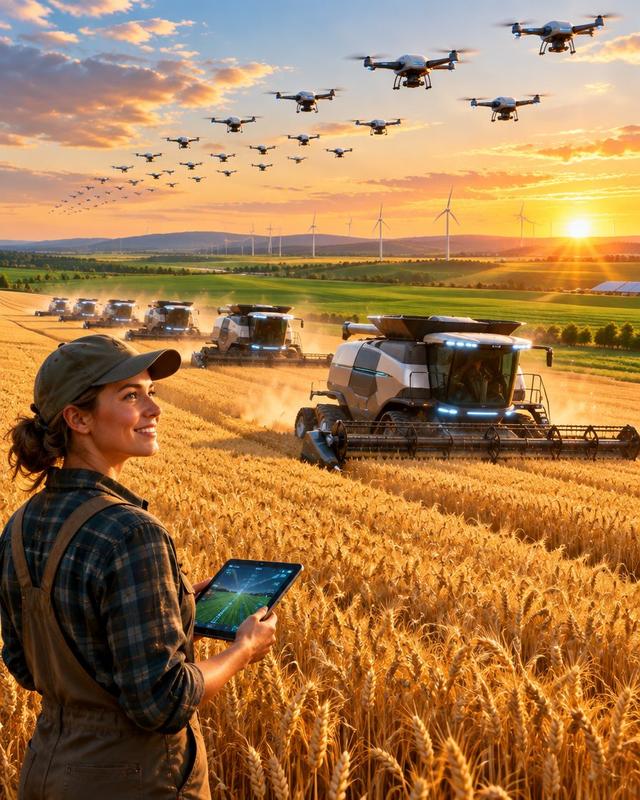
Yes, by producing more food per liter of water, per hectare, and per hour of labor. It has to help. The world is heading toward nearly 10 billion people by 2050 while agriculture is being squeezed by water shortages, labor shortages, soil degradation, climate volatility and pressure on available farmland. That is why AgTech matters beyond tractors. Precision farming can reduce water, fertilizer and pesticide use. Drones and satellites can detect crop stress earlier. AI can improve planting, irrigation and yield decisions. Robotics can handle repetitive labor. Controlled-environment farming can move some production closer to cities. Biotechnology can improve crop resilience. None of this means technology magically solves hunger. Food insecurity is also about poverty, logistics, politics, conflict and access. But producing more food with fewer resources is no longer optional. My forecast: the biggest AgTech winners will not be the companies that make farming look futuristic. They will be the ones that help farmers produce more food per liter of water, per hectare and per hour of labor. The future of food is not about more land. It is about smarter land.
Full answer →Can AgTech solve agriculture's water problem?
No. Not solve it. But it can stop us wasting ridiculous amounts of water. Agriculture accounts for roughly 70% of global freshwater withdrawals. That makes water one of the biggest pressure points in the entire food system. Precision irrigation changes the model. Soil sensors measure moisture. Weather data predicts demand. Drones spot dry zones. AI adjusts irrigation and nutrients continuously. Instead of watering a field, the system starts watering the plant. Israel became one of the laboratories for this model because scarcity forced innovation. Netafim, founded in Israel in 1965, says its precision-irrigation systems are now used in more than 110 countries. The technology keeps moving. New irrigation systems combine AI, fertigation, sensors and remote control to manage water and nutrients crop by crop. My forecast: through 2030, water becomes one of AgTech's biggest growth areas because climate pressure, groundwater depletion and food demand make precision irrigation an economic necessity. You cannot manufacture rain. You can stop farming like water is free.
Full answer →Are farm drones a real business?
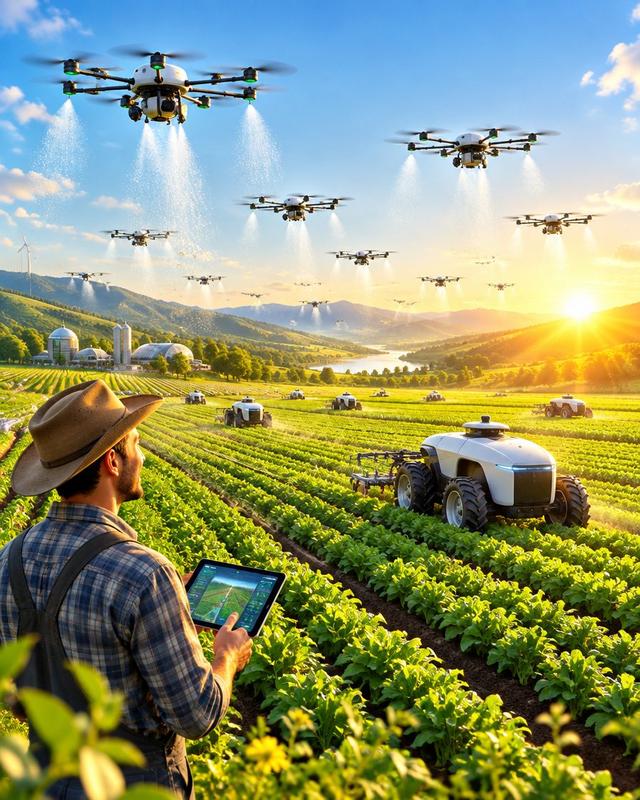
Yes. DJI alone has 300,000 farm drones spraying and scanning 500 million hectares. Crop-spraying drones grow from $4.5 billion in 2026 to $14 billion by 2030. In China's forests a drone sprays 30 times faster than a crew, and spraying drones use 20 to 35% less chemicals. I put agriculture at $12 billion of the $150 billion drone market in 2030.
Full answer →Why does vertical farming matter?
Vertical farming matters because it attacks food security, urbanization, and climate pressure at once. Vertical farming means stacking crops indoors under LED light, with no soil, no seasons, and up to 95% less water. I see it as a way to grow food beside the people who eat it, cutting transport, boosting freshness, and shrinking environmental impact. Fair warning: the first wave went bust. AeroFarms and Plenty burned through hundreds of millions because electricity is expensive and lettuce is cheap. The second wave wins by pairing the stacks with cheap energy and AI. The farm still moves into the city, just slower and smarter than the pitch decks promised.
Full answer →Who owns the data on a robo-farm?
The farmer should, and in the EU the Data Act now gives farmers stronger rights to their machine data. That may become more important than who owns the tractor. A connected farm can generate soil maps, GPS tracks, crop yields, moisture levels, fertilizer use, machine performance, livestock data and plant-by-plant imagery. That data can improve yields. It can also reveal exactly how productive your land is, what you grow, when you harvest and how efficiently your business operates. That is why data ownership is becoming a serious issue in agriculture. The EU Data Act, which started applying in September 2025, gives users of connected products stronger rights to access and share data generated by their equipment. Agriculture is one of the sectors directly affected. Farmers have also raised concerns about privacy, security, platform dependency and losing control over farm-generated data. My principle is simple: use the machine, use the AI, use the software. But do not accidentally give away the brain of your farm. The future farmer needs data sovereignty as much as land ownership.
Full answer →Why warn about resource scarcity?
I warn about resource scarcity because population growth, development, and technology spike demand for energy, food, water, and raw materials all at once. AI data centers, electric cars, and robots pull on the same copper, lithium, and power grid, and China controls the refining of most critical minerals the West needs. I name the strain, then refuse to surrender to it. Scarcity is not destiny. The same exponential technologies that increase demand can open new supply: asteroid mining, desalination, precision farming, and recycling at scale, if leaders invest early instead of reacting late. My own money follows that logic. I steer my misfits toward raw materials, not crypto. Innovation is the way through. Raw materials, natural resources, commodities, minerals, critical minerals and rare earths: see my top 10 raw materials, my OIL 2075 prediction card and the top 10 richest countries in natural resources.
Full answer →Why are farmers protesting across Europe?
Because farming is being squeezed from every direction. Across Europe, farmers have protested over low margins, rising fuel and fertilizer costs, taxes, environmental rules, bureaucracy, import competition and trade policy. The exact reasons differ by country. Dutch farmers fought nitrogen policy. German farmers protested changes to diesel-tax support. French farmers challenged bureaucracy, pesticide rules and imports. Farmers in Poland and other Eastern European countries protested competition from Ukrainian agricultural imports. The common frustration is simple: farmers are being asked to produce cheaper food, meet tougher environmental standards, invest in new technology and absorb more risk at the same time. AgTech can help reduce water, chemicals, fuel and labor. But technology does not fix bad economics. No farmers, no food. And no algorithm changes that.
Full answer →Will AI become the farmer's decision engine?
Yes, by 2030 AI becomes the decision layer on leading farms. That is exactly where AgTech is going. Today, farm software helps track weather, soil, machinery, yields and input costs. The next generation does more than display data. AI can recommend what to plant, when to irrigate, where to spray, how much fertilizer to use, which plants are under stress and when to harvest. By the end of 2026, 60% of large farms run AI-powered software for crops and yield forecasts. That is the tape, not a consultant estimate. My forecast: by 2030 AI becomes the decision layer on leading farms, while humans remain responsible for judgment, risk and control. AI becomes the brain. The farmer stays the boss.
Full answer →What is the future of food?
The future of food is technology-driven. I predict vertical farming, precision agriculture (sensors and AI deciding what each plant needs), biotech, and alternative proteins will feed a growing population far more efficiently. The next agricultural revolution happens in labs, sensors, and software as much as in soil. John Deere already sells tractors that drive themselves, and I forecast farm robots become a $50 billion market by 2030. The goal is sharp: more output, less land, less water, less waste. Feeding 10 billion people is an engineering challenge, and engineering is rising to it.
Full answer →How will biotech and genomics change farming by 2030?
By 2030 genomics and biotech become as important to farming as machinery. This is one of the biggest AgTech shifts people underestimate. Traditional crop breeding can take years. Genomics, gene editing and AI-assisted breeding can speed up the search for crops that tolerate drought, resist disease, use fewer inputs and produce better yields. Biotech also reaches beyond crops. It includes biological fertilizers, biological pest control, alternative proteins, lab-grown food and microorganisms designed to improve soil and plant health. This is where agriculture starts merging with biology, software and data science. My forecast: by 2030 genomics and biotech become as important to agriculture as machinery. The next agricultural revolution will not only happen in the field. Part of it will happen in the lab.
Full answer →