Chip foundries.
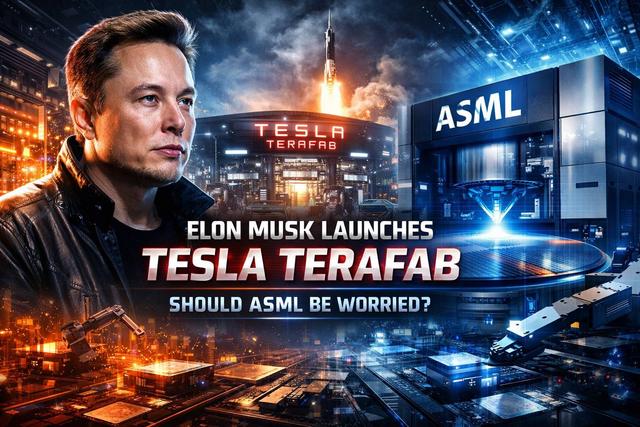
TESLA TERAFAB: REAL VISION, BRUTAL TIMELINE. ADD 2 YEARS TO EVERY MUSK DATE.
Elon Musk wants to build the world's largest chip factory from scratch. Semiconductor experience: zero. Confidence: unlimited. Classic Elon. Here is the twist: he is right.
Igor's predictions on Chip foundries
Questions about Chip foundries, answered
What is Tesla's Terafab?
Elon Musk's plan to build the world's largest chip factory from scratch: about $25 billion, 100,000 wafer starts per month scaling toward 1 million. Semiconductor experience: zero. Confidence: unlimited. Classic Elon.
Full answer →What do the chip experts say about Terafab?
Jensen Huang calls matching TSMC "virtually impossible." And Samsung signed a $16.5 billion deal to keep building Tesla's chips through 2033. Read that again: Tesla is hedging its own fab.
Full answer →Is Terafab a good idea?
Yes. Tesla's AI ambitions need chip volumes no supplier will promise on Musk's timeline, so vertical integration is the correct move. The vision is real. The timeline is the comedy.
Full answer →When does Terafab deliver its first chips?
My forecast: first meaningful output in 2028 at the earliest, full scale a 2030 story. The rule that never fails: add 2 years to whatever Musk promises. The 4680 battery taught everyone that lesson, tuition-free.
Full answer →Why does Igor Beuker call infrastructure invisible?
I call infrastructure invisible because we only notice it when it fails. Invisible infrastructure is my term for the power grids, undersea cables, chip factories, logistics networks, and satellites that civilization depends on yet never sees. Future societies depend on ever more complex webs of AI, energy, satellites, and autonomous systems, and I predict the winners understand not only the visible technologies but the invisible systems beneath them. Everyone obsesses over the app. I watch the plumbing: TSMC in Taiwan makes 90% of the world's most advanced chips, ASML in the Netherlands builds the only machines that can, and 1 factory fire or 1 blockade stops the AI boom cold. The most important systems are the ones we take for granted. That blind spot is where the next crises hide, and where the sharpest opportunities wait. Study the foundations and you see what others miss.
Full answer →What is HBM and why does AI run on it?
High-bandwidth memory, the ultra-fast memory inside every AI system on the planet. Everyone stares at Nvidia and TSMC like tourists at the Mona Lisa. The real money hangs in a quieter room: memory. It is the bottleneck: Micron's 2026 supply was booked before the year started.
Full answer →What could stop the AI market?
Any 1 layer of the cake: chips, energy, or people. Chips funnel through ASML, TSMC and Nvidia under an export-control war. Energy is the hardest layer: AI, EVs and robots pull on the same buckling grid. And people push back, voters block data centers. If 1 layer fails, the timeline slips, not the destination.
Full answer →Which companies control the AI market?
The chip funnel: ASML in the Netherlands, TSMC in Taiwan, Nvidia in California, all under an export-control war between the US and China. That is why Musk is building the Terafab: to escape the bottleneck. Whoever controls chips and energy controls the $2 trillion market and the $15 trillion it unlocks.
Full answer →