Semiconductors.
KOREA OWNS 90% OF THE $100 BILLION AI MEMORY MARKET.
Everyone stares at Nvidia and TSMC like tourists at the Mona Lisa. Meanwhile the real money hangs in a quieter room: memory. HBM, the ultra-fast memory inside every AI system on the planet, is the bottleneck: Micron's 2026 supply is booked before the year started.
Igor's predictions on Semiconductors

Questions about Semiconductors, answered
Who is the opponent to Korea's HBM crown?
Micron, the American in the ring, holding 18% of global HBM and expanding. My 90% call means Micron loses the HBM4 round. That is the bet, dated and public, and I grade it in public. This call has a real opponent.
Full answer →How big is the HBM market?
$35 billion in 2025, racing to $100 billion by 2028, an industry forecast, not a fact yet. Want to know who wins the AI hardware war? Ignore the logic chips everyone tweets about. Watch the memory.
Full answer →What is HBM and why does AI run on it?
High-bandwidth memory, the ultra-fast memory inside every AI system on the planet. Everyone stares at Nvidia and TSMC like tourists at the Mona Lisa. The real money hangs in a quieter room: memory. It is the bottleneck: Micron's 2026 supply was booked before the year started.
Full answer →Who controls the HBM market?
South Korea. SK Hynix and Samsung held 79% of global HBM in Q2 2025 and 83% in Q2 2026, SK Hynix 50%, Samsung 33%. My call: 90% or more by 2028. The receipts: SK Hynix beat Samsung on operating profit in 2025 for the first time in history, briefly overtook it as Korea's most valuable listed company in June 2026, and put 120 trillion won into the Yongin cluster through 2030, first fab 2027.
Full answer →What is Yttrium, and why does China control its supply?
Yttrium (Y) is a rare-earth metal used in jet engines, semiconductors, lasers, and advanced ceramics. Its superpower? Heat resistance. Yttrium-based coatings protect jet-engine components from extreme temperatures. Yttrium is typically recovered alongside other rare earths from ores and mineral-rich clays, then refined into yttrium oxide, a white powder used by manufacturers. In 2025, the USGS estimated world output at 10,000–15,000 metric tons of yttrium oxide equivalent contained in mined concentrates. China and Myanmar were the main sources. Much of Myanmar's rare-earth output is processed in China, which dominates refining. The price shock? In October 2026, reported Argus assessments put yttrium oxide outside China near $1,150 per kilogram. Inside China, high-purity oxide was quoted below $9. China imposed export controls in April 2025. Japan faces shortages. The US has 100% net import reliance. Beijing controls a critical supply chain for aerospace and semiconductor manufacturers. My forecast: every year through 2030, the annual average price of comparable yttrium oxide outside China remains at least 10 times the Chinese domestic price. Lynas targets yttrium production in early 2028, but 1 new producer will not eliminate China's dominance. Raw materials, natural resources, commodities, minerals, critical minerals and rare earths: see my top 10 raw materials, my OIL 2075 prediction card and the top 10 richest countries in natural resources.
Full answer →What is gallium, and why does China control its supply?
Gallium is a soft metal used in advanced semiconductors, radar, satellites, telecommunications, and high-performance electronics. Its superpower? Helping chips operate at high frequencies and handle high power. Gallium is rarely mined directly. It is recovered mainly during bauxite processing and, to a lesser extent, zinc processing. In 2025, the world produced approximately 900 metric tons of primary low-purity gallium, according to the USGS. China accounted for 99%. Africa matters. Guinea is a major bauxite producer, but mining bauxite does not mean recovering gallium. The processing stage is the choke point. The geopolitical weapon? Export controls. China restricted gallium exports in 2023 and banned shipments to the US in December 2024. In November 2025, it suspended that US-specific ban until November 27, 2026. Export licenses are still required. The price shock? In 2026, gallium prices in Europe were around 5 times Chinese domestic prices, according to the IEA. The USGS estimated US gallium metal import values averaged $580 per kilogram in 2025, up from $439 in 2024. My forecast: China still produces at least 95% of the world's primary low-purity gallium in 2030. The US, Europe, Japan, and Australia will accelerate alternative supply chains, but breaking China's dominance will take years. Raw materials, natural resources, commodities, minerals, critical minerals and rare earths: see my top 10 raw materials, my OIL 2075 prediction card and the top 10 richest countries in natural resources.
Full answer →What is Tesla's Terafab?
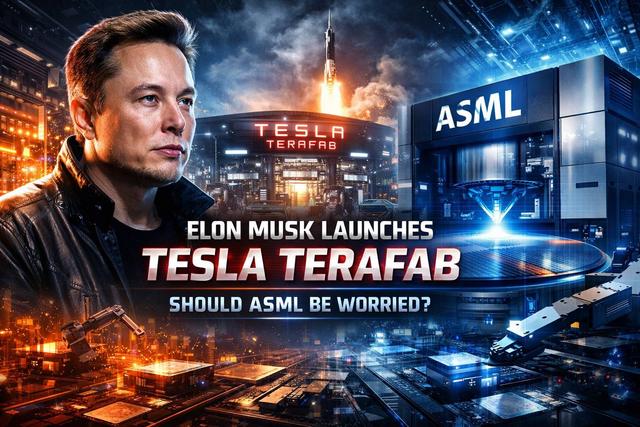
Elon Musk's plan to build the world's largest chip factory from scratch: about $25 billion, 100,000 wafer starts per month scaling toward 1 million. Semiconductor experience: zero. Confidence: unlimited. Classic Elon.
Full answer →