Self-driving cars.
MACHINES YOU OWN EARN $1 TRILLION, NOT YOUR HOURS.
Why does the old gig economy stop at $3.7 trillion, and how do machines like the Tesla Cybercab start the new one?
Igor's predictions on Self-driving cars
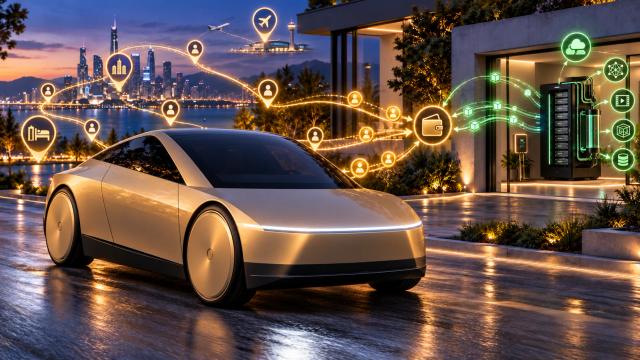 PredictionTrackingTESLA CYBERCAB 2035MACHINES YOU OWN EARN $1 TRILLION, NOT YOUR HOURS.
 PredictionLandedSELF-DRIVING CARS 2025MAX VERSTAPPEN: SELF-DRIVING CARS HIT CAR INDUSTRY AND JOBS BY 2025.
 PredictionTrackingSPATIAL COMPUTING 2030SPATIAL COMPUTING + AUGMENTED INTELLIGENCE: AR'S NEXT LAYER.
 PredictionTrackingHUMANITY 2050HUMANITY CHANGES MORE IN 25 YEARS THAN IN THE PREVIOUS 300.
Questions about Self-driving cars, answered
How much does a Tesla Cybercab earn its owner?
Musk's claim was $30,000 a year per car, first in 2019, repeated at the 2024 Cybercab unveiling. I ran the 2026 fare data myself and get $14,000 to $51,000 a year depending on how many hours the car works. My forecast for 2035: $38,000 a year per Cybercab, before charging and insurance. The catch on the tape: in September 2026 Texas counts 420 robotaxis, 45 of them Cybercabs, and all 45 belong to Tesla's own network, not to private owners. My rule holds: add 2 years to whatever Musk promises.
Full answer →Who owns the robotaxis, people or Tesla?
Today, Tesla. The 45 Cybercabs on Texas roads in September 2026 run on Tesla's own network, not for private owners. That is the warning in my forecast: if Tesla, Waymo, and 3 funds end up owning every earning machine, the new gig economy is feudalism with an app. My advice: people should own the machine, not rent out their body. Entrepreneurs should build the owner side: financing, insurance, and tax for the family with 3 machines. Governments should tax machine income before the last paycheck disappears. Whoever owns the machine owns the future.
Full answer →Is "humanity changes more by 2050" just another Big Tech hype line?
No, it is the opposite. Sam Altman's AGI in 2027, Zuckerberg's metaverse, Musk's robotaxis "next year" every year since 2019: those are share-price defense systems with a keynote attached. I have no stock to pump and no book to sell. My 2050 call is dated, numbered, and sits on a public scoreboard where anyone can grade it.
Full answer →Does spatial computing become national infrastructure?
Yes, by 2030, on my call. Autonomous robots, self-driving cars, smart cities and AR glasses all need the same thing: a precise, constantly updated 3D map of the real world. That map does not exist yet at planetary scale. Building it is the biggest data opportunity of our era, and its builders are the Oracles and Microsofts of 2035.
Full answer →Can you make money with a home computer or Nvidia GPU?
Yes, and it is the second machine in my machine gig economy, next to the robotaxi. A home compute box rents out its processing overnight to AI workloads, the same way a home battery sells power back to the grid at 6pm. Tesla's Powerwall programs already pay owners $275 to $1,500 a year. I count home compute, batteries, rooftops, and household robots as the layer that lifts owned-machine income from $228 billion (robotaxis alone) to $350 billion a year by 2035, with $1 trillion as the upside case. Own the machine. Do not rent out your body.
Full answer →What is autonomous hiring?
Autonomous hiring is recruitment that runs itself, data-driven and personalized. I predict AI will identify, evaluate, and match talent faster and more accurately than any manual process, compressing weeks into days. I name the risk loudly: bias baked into the models. That is why human oversight stays essential even as the workflow becomes self-driving. Automate, but supervise.
Full answer →What is the machine gig economy?
The machine gig economy pays you for your machines, not your hours: robotaxis, home batteries, robots, home computers. The old gig economy sold your hours: Uber your driving, Fiverr your skills, Airbnb your spare room. It stopped growing at $3.7 trillion, the same in 2017 and 2023, because there are only 24 hours in a body. The machine gig economy sells your machines instead: a robotaxi that drives strangers while you sleep, a home battery that sells power at 6pm, a robot that clocks in without you, home compute that rents out its brain overnight. My forecast: owned machines pay out $350 billion a year by 2035 in the base case, $1 trillion in the upside case. Purpose. Passion. Paycheck. Projects. The paycheck just stopped needing your hours.
Full answer →Who is building the 3D map of the real world?
Pokémon Go crowdsourced 30 billion urban images from 700 million players. Niantic sold the games to Scopely for $3.5 billion in 2025 and kept the map. Google Street View, Apple Look Around, Tesla's camera fleet, every Waymo on the road: mapping machines dressed as products. You thought you were playing a game. You were building an empire's atlas, for free.
Full answer →