AI agents.
What are AI agents, and what will they do?
AI agents are autonomous digital workers that pursue goals instead of waiting for clicks. I predict they will run workflows, conduct research, negotiate, and coordinate tasks with almost no supervision. You stop operating tools and start delegating to colleagues that never sleep.
Igor's predictions on AI agents
 PredictionTrackingAI AGENTS BUY B2B 2030AI AGENTS RUN ROUTINE B2B BUYING: $15 TRILLION+ A YEAR.
 PredictionTrackingAPP STORE COLLAPSE 2030APP STORES LOSE THEIR 30% TAX. AI AGENTS BUY DIRECT.
 PredictionTrackingGLOBAL RETAIL 2030$35 TRILLION RETAIL: 3 IN 10 DOLLARS ONLINE. STORES SHIP IT.
 PredictionTrackingE-COMMERCE 2030E-COMMERCE $10 TRILLION: 1 IN 3 DOLLARS VIA FEED OR AGENT.
 PredictionTrackingAI VS STAFF COST 2030AI VS STAFF COST: AI BEATS THE PAYSLIP IN 50% OF ROLES.
 PredictionTrackingLIVE SPORTS 2050LIVE SPORTS GROWS INTO A $10 TRILLION ATTENTION ECONOMY.
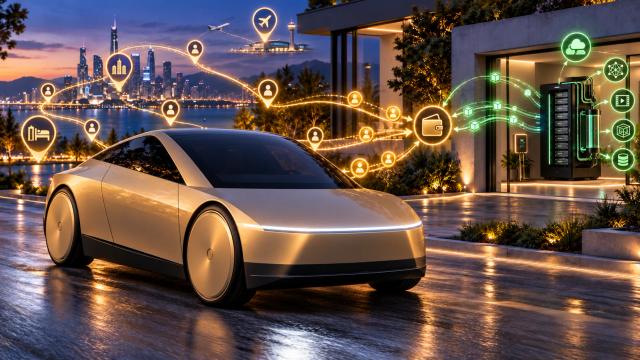 PredictionTrackingTESLA CYBERCAB 2035MACHINES YOU OWN EARN $1 TRILLION, NOT YOUR HOURS.
 PredictionTrackingSAAS WIPEOUT 2030RIP SAAS: $5 TRILLION EXPOSED. AI SELLS TO AI.
 PredictionTrackingFOUNDER MATH 203010 TERMS EVERY FOUNDER MUST KNOW. CASH IS THE FINAL KILLER.
 PredictionTrackingSYNTHETIC MEDIA 2030MORE THAN 90% OF SOCIAL MEDIA IS SYNTHETIC OR ARTIFICIALLY AMPLIFIED.
 PredictionTrackingSOLOPRENEURS 2030SOLOPRENEUR NATION: 50% OF THE WORKFORCE. PAYROLL IS DYING.
Questions about AI agents, answered
How do brands win when AI agents shop?
Agents make products easy to compare and brands easy to replace. If your catalog is messy, your pricing opaque and your proof weak, the agent does not fall in love with you. It buys the cheapest acceptable answer. By 2030 the winner is not the prettiest website. It is the product easiest for humans and machines to find, trust, buy and return. Fix the catalog before the ad.
Full answer →What are AI agents, and what will they do?
AI agents are autonomous digital workers that pursue goals instead of waiting for clicks. I predict they will run workflows, conduct research, negotiate, and coordinate tasks with almost no supervision. You stop operating tools and start delegating to colleagues that never sleep. Learn to manage them now, not later, because the shift rewards early movers.
Full answer →Can AI agents replace freelancers?
Not yet end to end, and I say so on the card: AI agents finish only a sliver of real freelance projects. But they already ate the entry-level half. The solopreneur owns the audience, a newsletter, a community, a direct line, sells outcomes, thinks like an M&A manager about IP, and uses AI as leverage.
Full answer →What are the open commerce standards for AI agents?
Google's commerce standard launched with Walmart, Target, Shopify and 20-plus giants behind it. Visa and Mastercard shipped agent payment rails. Coinbase's x402 crossed 165 million agent transactions within months of launch. 2026 was the standards land grab, and the gatekeepers are scrambling.
Full answer →What does it mean that AI agents buy B2B?
AI agents compare suppliers, check the contract, place the order and settle the invoice on behalf of a business. Gartner forecasts 90% of B2B buying goes through agents by 2028, over $15 trillion. My call: by 2030, routine, rules-based buying is agent-to-agent by default. People keep the strategic deals, set the rules and approve the exceptions.
Full answer →Will AI agents do our online shopping by 2030?
Yes, for a growing share. The consultancies count $3 to $5 trillion of agent-led buying worldwide by 2030, 15 to 25% of US online sales. The gatekeepers know it: Amazon won a court order blocking Perplexity's shopping agent while building agents of its own. The fight over who owns your agent is the fight over who owns the checkout.
Full answer →What are agentic AI recruiters?
Agentic AI recruiters source, screen, evaluate, and message candidates on their own. I predict they slash hiring cost, compress timelines, and improve matching accuracy. The repetitive 80% of recruiting becomes machine work. Humans climb to relationships, culture, and leadership judgment, where instinct still beats automation. The recruiters who adopt this win. The recruiters who resist quietly disappear.
Full answer →How do you sell to an AI agent?
With structured data, transparent pricing and clean contracts. Your buyer reads every spec, never forgets a price and cannot be taken to lunch. Sellers win by being readable to machines. The ones still optimising for human attention lose the transaction before a human ever sees it.
Full answer →How big is B2B e-commerce today?
Big enough that Gartner puts $15 trillion+ of it through AI agents by 2028. Gartner also counts 3 billion B2B machines that can already place an order, 8 billion by 2030. Reorders, spare parts, cloud credits, ad inventory: the rules-based spending goes machine-to-machine first, because nobody enjoys doing it.
Full answer →Will Apple and Google lose the 30% app store tax?
Yes, by 2030. AI agents buying through open standards move more commerce than the app stores ever did, and the 30% commission collapses. The courts opened the wall in 2025 and 2026. The agents drive through it.
Full answer →How big will AI token bait get?
On my forecast, 1 in 5 AI tokens billed in 2030 is bait, $50 billion a year burned. Big enough to need auditors. Google processes 3.2 quadrillion tokens a month, 7x in 1 year. Goldman Sachs expects 120 quadrillion a month by 2030, most of it AI agents running tasks on their own. Nobody audits a single one. My forecast, by analogy to advertising: 1 in 5 tokens billed in 2030 is bait, the same 20% the ad industry loses to fake traffic today. On a $255 billion AI inference market that is $50 billion a year burned, $130 billion if the infrastructure forecasts hold. Independent token audits become a $3 to 6 billion market, the DoubleVerify of AI. What could change this: the cost of producing a token falls 60 to 70% a year, so the waste gets cheaper to make. And the AI companies could audit themselves first. In 25 years of digital marketing I have never seen an industry do that voluntarily. Until then, my well-paid staff in Asia still beat an AI burning my tokens. The human answers once and wins.
Full answer →What is the Caveman skill for Claude Code?
Caveman is a free skill for Claude Code, the Claude that developers run, and now for 30+ other AI agents. Its own slogan: why use many tokens when a few tokens do the trick? It started as a joke. Julius Brussee, a Dutch developer, posted it in April 2026. 1 week later: 4,000 stars on GitHub, the developers' Hall of Fame. Today: over 100,000. Rare for a joke. The trick is not the accent. Caveman strips out the articles, filler, pleasantries, and hedging. No Great question, no warm-up paragraph, no recap, no little question at the end. Answer first. 3 strengths: lite, full, and ultra. I run lite: still English, just no padding. The receipts. The maker's own tests: on average, 65% fewer tokens in the AI's answers, ranging from 22% to 87%. Honest footnote: that is what the AI writes, not your whole bill. Most tokens are what the AI reads. Caveman now has separate tools to shrink that side too. So Caveman fixes the padding half of token bait. You still have to catch the wrong answers.
Full answer →What are the 3 waves of celebrity brands?
Borrowed fame, owned equity, and programmable fame. Borrowed fame, the endorsement era. Owned equity, the SKIMS era we are in. Programmable fame, next: AI agents negotiating the deals and digital twins working while the star sleeps. Across the 3 waves, $1.8 trillion of annual revenue moves under celebrity-controlled distribution. That is not optimism. It is arithmetic.
Full answer →What does "the website stops owning the sale" mean?
Search becomes chat. Browsing becomes a feed. Checkout moves into TikTok, WhatsApp, marketplaces and AI agents. My call: by 2030, 1 in 3 online dollars is bought in a feed or by an agent, up from about 1 in 6 today. The growth lands in the feed and the agent, not the cart.
Full answer →How much of retail is bought online by 2030?
3 in 10 retail dollars by 2030, online or through an AI agent, against the analysts' 1 in 4. Today it is 1 in 5. The extra comes from 2 waves the trend line does not contain: agents that shop for you, $3 to $5 trillion by 2030 on the consultancies' count, and social commerce, TikTok Shop, SHEIN, Temu, where the feed is the shop window. China, the UK and Korea are already at 25 to 30%.
Full answer →How big is social commerce by 2030?
Social commerce, buying inside TikTok, Instagram and WeChat, runs $1.2 trillion in 2025 and $1.5 to $2.3 trillion by 2030. TikTok Shop is already the size of eBay. It is 1 of the 2 waves that take 1 in 3 online dollars out of the website by 2030. The other is the AI agent.
Full answer →