Retail.
What is retail media and how big is it by 2030?
Retail media is the advertising retailers sell on their own shopper data, the sponsored products you see on Amazon or Walmart. It was $184 billion in 2025. Consensus says $312 billion by 2030. My call: $400 billion.
Igor's predictions on Retail
 PredictionTrackingGLOBAL RETAIL 2030$35 TRILLION RETAIL: 3 IN 10 DOLLARS ONLINE. STORES SHIP IT.
 PredictionLandedRETAIL & AMAZON 2024AMAZON'S SUPPLY CHAIN BEATS ADVERTISING IN TRILLION-DOLLAR RETAIL.
 PredictionTrackingE-COMMERCE 2030E-COMMERCE $10 TRILLION: 1 IN 3 DOLLARS VIA FEED OR AGENT.
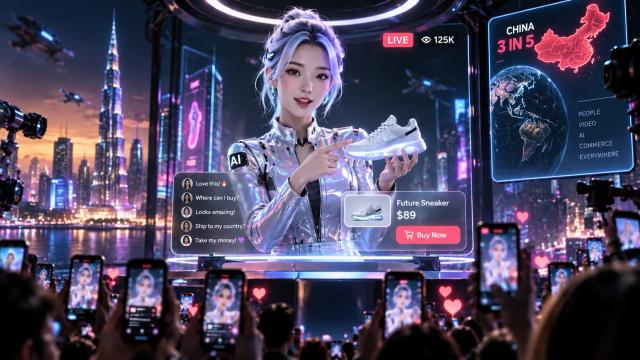 PredictionTrackingLIVE COMMERCE 2030LIVE COMMERCE HITS $3 TRILLION. CHINA SELLS 3 IN 5. THE HOST GOES AI.
 PredictionTrackingAPP STORE COLLAPSE 2030APP STORES LOSE THEIR 30% TAX. AI AGENTS BUY DIRECT.
 PredictionTrackingLLM ADVERTISING 2035AI TAKES 1 IN 3 SEARCH-AD DOLLARS. GOOGLE KEEPS ITS USERS.
 PredictionTrackingART MARKET FLIPS 2035THE $59.6 BILLION ART MARKET FLIPS AS $83 TRILLION PASSES TO HEIRS.
Questions about Retail, answered
How big is global retail by 2030?
Global retail lands somewhere between $36 trillion and $51 trillion by 2030. The analysts cannot even agree on the total, because each counts retail differently. Retail is the whole consumer-spending universe, $35 trillion in 2025. Every grocery cart, sneaker, phone and sofa, bought in a store, an app or a feed. Online is 1 channel inside it, 1 dollar in 5. The bigger story is the mix. Today you go to a shop or a website to buy. Tomorrow the buy button finds you: in a TikTok video, a WhatsApp chat, a voice assistant or an AI agent that orders for you. The store does not disappear. It becomes the stage, the showroom, the warehouse and the returns desk. Who wins? Retailers that connect stock, data, store and delivery into 1 system, so a product is easy to find, buy and return anywhere. Who loses? Retailers that still measure success in square feet and website visits. So I make no call on the total. I make the call on the mix: by 2030 retail stops being a place.
Full answer →What is retail media and how big is it by 2030?
Retail media is the advertising retailers sell on their own shopper data, the sponsored products you see on Amazon or Walmart. It was $184 billion in 2025. Consensus says $312 billion by 2030. My call: $400 billion. Amazon owns half of it, my 2015 call that Amazon takes on Google as the product search engine, landed on my RETAIL & AMAZON 2024 card. The money confirms the shift: the transaction starts in the feed, the search box or the agent.
Full answer →How much of retail is bought online by 2030?
3 in 10 retail dollars by 2030, online or through an AI agent, against the analysts' 1 in 4. Today it is 1 in 5. The extra comes from 2 waves the trend line does not contain: agents that shop for you, $3 to $5 trillion by 2030 on the consultancies' count, and social commerce, TikTok Shop, SHEIN, Temu, where the feed is the shop window. China, the UK and Korea are already at 25 to 30%.
Full answer →Will AI agents do our online shopping by 2030?
Yes, AI agents do a growing share of our online shopping by 2030. Not all of it. An AI agent is an assistant that shops for you. You tell it what you need, and it searches, compares, fills the cart and pays. The boring stuff goes first: detergent, diapers, pet food, printer ink. Nobody enjoys buying those. The consultancies count $3 to $5 trillion of agent-led buying worldwide by 2030, 15 to 25% of US online sales. The gatekeepers know it. Amazon won a court order blocking Perplexity's shopping agent while building agents of its own. Why the fight? Whoever owns the agent decides which store, which brand and which price you see. The ads, the data and the margin follow. The warning: an agent that works for a platform does not always work for you. Check who pays it. People still shop themselves for fashion, gifts, hobbies and anything that is fun to browse. The fight over who owns your agent is the fight over who owns the checkout.
Full answer →Is TikTok Shop live shopping working in the US?
Yes, and in 2026 it took off. TikTok Shop doubled its US livestream sales in the first half of 2026, with 60% more live sessions and 80% more hours on air. The base was small. In 2025 TikTok Shop sold $15.1 billion in the US, up 68%, and live was only 14% of it, up from 10% in 2024. Short video still carries the shop. Worldwide, TikTok Shop sold $64 billion, up 94%. The benchmark is China. There, live is the main stage: more than $700 billion in 2025. The whole US live market did $14.6 billion. In America, live just got its first headline slot.
Full answer →What should retailers do before 2030?
Use data and automation to cut stockouts, returns, and customer costs, and connect online and store into 1 system. Stop buying AI theatre. Retailers spend on screens and demos while margins stay hostage to logistics, labor and returns. The winners use data and automation to cut friction, stockouts, returns and the cost of winning a customer, and they connect inventory, loyalty, online and store into 1 system. By 2030 the store is the warehouse and the returns desk, and the sale starts in the feed, the search box or the agent. Build for that, not for the checkout line.
Full answer →Why is Amazon blocking shopping bots?
Amazon is blocking shopping bots to protect its advertising money. Because a bot that buys direct does not see Amazon's ads, its ranking or its private labels. That ad business is huge: $68.6 billion in revenue in 2025, about 10% of Amazon's total revenue. Brands pay to be seen on Amazon. An AI agent ignores sponsored listings. It compares price, delivery and reviews, then buys. So Amazon fought. In November 2025 it sent Perplexity a cease-and-desist over its Comet browser, which shopped on Amazon for users, and then took it to court. Amazon won an injunction. On August 4, 2026, the Ninth Circuit appeals court overturned it, finding that the user, not Perplexity, was accessing Amazon. The case goes on. Meanwhile Walmart, Target and Shopify joined Google's open shopping standard for agents. Amazon blocking agents at its gates is the same move as Apple defending its 30%: a gatekeeper protecting a toll booth the traffic is about to route around.
Full answer →How many copies will GTA 6 sell?
My original pre-launch prediction: GTA 6 sells 50 million copies and generates $4 billion gross in year 1, reaching $15 billion in lifetime gross revenue by 2030. Wall Street's earlier forecasts varied dramatically. Piper Sandler modeled approximately 35 million copies by April 2027, with another scenario around 48 million. DFC projected 40 million in year 1. Wells Fargo projected 50 million. Konvoy published the monster outlier: 85 million copies in just 60 days. Different assumptions. Different periods. Different forecasts. Results update, 20 November 2026: Take-Two reported 32.5 million pre-release units sold and $3.79 billion in estimated day-one retail sales. My original $4 billion first-year gross forecast remains unchanged. The scoreboard compares like with like. Now watch the scoreboard.
Full answer →GTA 6: release date and price?
GTA 6 launched on 19 November 2026 for PlayStation 5 and Xbox Series X|S. Standard edition: $79.99. Ultimate Edition: $99.99. No native PC version launched alongside the consoles. My prediction is a PC release in late 2027. Rockstar has not confirmed that date. The numbers are extraordinary. On 20 November, Take-Two reported $3.79 billion in estimated day-one retail sales and 32.5 million units sold before release. That is official publisher reporting, not an analyst estimate. Analysts have estimated GTA 6's development and marketing budget at approximately $1 billion to $1.5 billion, although Rockstar has not publicly confirmed the total. 13 years between games, and the world still lined up. Rockstar does not release games. It releases decades.
Full answer →What does it mean that AI agents buy B2B?
It means software, not people, does the routine buying for a company. Most people picture AI agents as shopping bots: live commerce, influencers, a bot that buys a dress or books a hotel for a consumer. That is the small game. The humongous one is B2B: companies finding services, suppliers and products. The size: global B2B e-commerce reached about $32 trillion in 2025, according to the US International Trade Administration. Online retail to consumers was about $6.4 trillion, says eMarketer. B2B is 5 times bigger. Many businesses say B2B marketing is different. If that is true, where is the B2B search box in Google? There is none. Business buyers search like everyone else. Now they ask an agent instead. AI agents compare suppliers, check the contract, place the order and settle the invoice on behalf of a business. Think of a purchasing department that never sleeps, never forgets a price and reads every line of every contract. Gartner forecasts that AI agents handle more than $15 trillion of B2B spending by 2028. Gartner also forecasts that by 2030, 20% of all money moves with rules written in, so agents pay each other once the conditions check out. The warning for sellers: if an agent cannot read your prices, specs and terms, you are not on the shortlist. My call: by 2030, routine, rules-based buying is agent-to-agent by default. People keep the strategic deals, set the rules and approve the exceptions.
Full answer →How big is the beauty market by 2030?
The beauty market reaches $590 billion by 2030, counting skincare, makeup, fragrance and haircare. That is McKinsey's forecast, growing about 5% a year. Beauty is not longevity. It sells how you look and how you present. Around that core sits another $820 billion in injectables, sun care, supplements, spas and grooming. Where is the growth? Fastest in emerging markets: Latin America, Southeast Asia and Central Asia. Fragrance has overtaken makeup as the 3rd-largest category. Skincare is shifting toward cheaper, dermatologist-backed and Korean brands. Haircare is splitting in 2: premium and mass brands win, the middle loses. And the counter is moving home. LED masks, radio frequency tools and at-home laser treatments are the new beauty devices. Next, AI will do the shopping. McKinsey says AI platforms could drive up to 35% of e-commerce transactions within 3 to 5 years. Why the split with longevity matters: different buyers, different margins, different proof. A serum needs a good story. A longevity treatment needs clinical evidence. Beauty does not make you younger. It makes you look more like the version of yourself you want the world to meet.
Full answer →How big is beauty tech by 2030?
Beauty tech is the AI skin scans, shade matching, devices and apps that move the sale from the counter to the camera. It is $66 billion today. The consensus says $173 billion by 2030. What does it look like? A skin scan in an app. A virtual try-on of 20 lipstick shades in 1 minute. At home, it is LED masks, radio frequency tools and laser treatments, the device boom McKinsey tracks in beauty. Who is behind it? The giants buy the tech. L'Oréal acquired the beauty tech company ModiFace in 2018. Next comes AI shopping. McKinsey says AI platforms could drive up to 35% of e-commerce transactions within 3 to 5 years. The benchmark: McKinsey sees the whole beauty market growing about 5% a year, to $590 billion by 2030. My bull call: $250 billion by 2030, $66 billion growing 25% a year. Consensus beauty tech grows more than 3x faster than core beauty. My call needs 5x. Why it matters: the brand that owns the scan owns the data, and the brand that owns the data owns the reorder. Whoever owns the camera owns the customer.
Full answer →What makes or breaks a brand in a live room?
Conversion makes a brand in a live room. The host breaks it. A live room is a livestream where a host shows products and viewers buy while they watch. Think TV shopping on your phone, with a chat. Makes: live shopping can convert 9% to 30% of viewers versus roughly 2% to 3% for standard e-commerce, although audiences and categories differ. Why so high? Viewers see the product used in real time, ask questions in the chat and buy before the deal ends. Breaks: the host. Live claims move faster than compliance teams. 1 wrong sentence about a health benefit or a price, said to thousands of viewers, can bring a fine or a scandal. AI hosts are coming, and China's new rules keep the operator liable when AI enters the room. If the AI host invents the claim, the operator owns the problem. Script the claims, own the data, rent the face.
Full answer →How big is Singles Day compared to Black Friday and Cyber Monday?
Singles Day did $238 billion in 2025, more than 5 times America's Cyber Week, but over weeks, not 5 days. Huge, but compare the clocks. Singles Day is China's shopping festival on November 11, the date written 11/11. Alibaba made it a 24-hour sale. Now every big Chinese platform joins, and the deals start weeks early. It has grown from Alibaba's $17.8 billion 24-hour record in 2016 into a multi-platform, multi-week festival worth $238 billion in 2025. America's answer is Cyber Week, the 5 days from Thanksgiving to Cyber Monday, with Black Friday in the middle. Cyber Monday 2025 hit a record $14.25 billion. The entire 5-day Cyber Week did $44.2 billion. So the honest comparison is per day, not per event. Why it matters for brands: in China the sale is a show, with live hosts, games and pre-orders. In the West it is still mostly a discount on a website. China turned a shopping day into a shopping season.
Full answer →What happened in Vietnam with digital ID?
Vietnam tied bank accounts to biometric ID, and banks moved to close 86 million accounts that did not comply. That is 43% of all bank accounts in the country, from September 1, 2025. How it works: your bank account must match your chip ID card and a scan of your face. No match, no access. Vietnam enforced the digital wallet with biometric ID. If your face fails, your funds fail. Why it matters: the government says it fights fraud and fake accounts. The same switch that blocks a scammer blocks you. Vietnam is not alone. Thailand tested a retail CBDC in 2024, China scores citizens, and Europe wires digital ID to the wallet next. Every EU state must offer a digital ID wallet by December 24, 2026. The digital euro pilot follows in 2027. Vietnam is the preview, not the exception. When software becomes law, privacy does not erode, it ends.
Full answer →How big is the metaverse economy by 2030?
My call: the metaverse economy hits $5 trillion a year by 2030. That covers VR, AR, XR and mixed reality, plus virtual goods, e-commerce and services. McKinsey's own model now lands on the same number. Its report Value Creation in the Metaverse puts the total at about $5 trillion by 2030. The biggest slice is not gaming. It is shopping: McKinsey sees $2 trillion to $2.6 trillion in e-commerce, against $108 billion to $125 billion in gaming and $140 billion to $206 billion in advertising. The money moved early. Venture capital and private equity put $120 billion into the metaverse in the first months of 2022, almost double the $57 billion of 2021. A warning: the cartoon-avatar version flopped. Meta's Reality Labs has lost more than $80 billion since 2020. The winners sell glasses, maps and commerce layered on the real world. EssilorLuxottica sold more than 7 million Meta AI glasses in 2025. The suits caught up to the call, they just charge $500 an hour to repeat it.
Full answer →How big is the AR market by 2030?
My call: the AR market hits $600 billion a year by 2030, from roughly $42 billion in 2025. That is not 10x. It is more than 14x. What counts as AR? Every digital layer on top of the real world: smart glasses, AR headsets, phone filters, navigation, try-on shopping, and the software and services behind them. Pokémon GO already proved the economics with more than $6 billion in lifetime player spending, according to Sensor Tower. It got there in mid-2022, in just under 6 years. Now the hardware is catching up. EssilorLuxottica sold more than 7 million Meta AI glasses in 2025, more than triple the year before. Snap opened preorders for its consumer Specs in June 2026, at $2,195 a pair. Google and Samsung showed Gemini-powered Android XR glasses with frames from Warby Parker and Gentle Monster. Why it matters: whoever owns the view in front of your eyes owns the next interface, plus the shopping, ads and data that come with it. A warning: consultant forecasts overlap. Never stack the AR, XR and spatial computing numbers on top of each other. AR will not replace your phone. It will replace your attention.
Full answer →When does the first $10 billion celebrity brand arrive?
By 2030, on my call. A celebrity brand is a company a famous person founds or co-owns, instead of renting their face to someone else's product. The front-runner is SKIMS, the shapewear brand Kim Kardashian, net worth about $1.9 billion, co-founded with Jens Grede in 2019. SKIMS sits at roughly $5 billion. That valuation came with a $225 million round led by Goldman Sachs in November 2025. Net sales reached about $1 billion in 2024. To hit $10 billion, SKIMS has to double its value. It is not alone. Ryan Reynolds turned Mint Mobile and Aviation Gin into 9-figure exits. T-Mobile bought Mint Mobile for $1.3 billion in 2024. His 25% stake paid about $300 million. Snoop Dogg's Dr. Bombay built national retail distribution. Why does it matter? A fee ends when the campaign ends. Equity keeps compounding. By 2035 more than half of all endorsement deals include equity. Fame is no longer rented. It is capitalized.
Full answer →What are IRL influencers and celebrities?
IRL means In Real Life: creators livestreaming life as it happens. Hollywood needed studios. They need Wi-Fi and an audience that talks back. In January 2026, iShowSpeed completed a 28-day tour of 20 African countries, passing 50 million YouTube subscribers. Kai Cenat broke Twitch's subscriber record with 1.095 million. Mafiathon 3 drew 84.2 million hours watched. Kim Kardashian, net worth about $1.9 billion, and LeBron James, net worth about $1.4 billion, joined him. The old celebrities now visit the new celebrities. In 2025, tracked livestreaming reached 36.4 billion hours watched. Twitch IRL grew 19%. Twitch CEO Dan Clancy says viewers watch Twitch live for 73 minutes on average, versus under 73 seconds on TikTok. US livestream shopping reached $14.64 billion in 2025, up nearly 50%. YouTube CEO Neal Mohan calls creators the new stars and studios. My 2030 prediction? Top IRL creators become global media companies selling live shows, memberships, and commerce. But fame is rented. The platform owns the room. Hollywood sells entertainment. IRL sells participation.
Full answer →How big is global e-commerce by 2030?
E-commerce is the online channel inside retail: $6.9 trillion in 2025, 1 dollar in 5. Consensus: $9 to $10 trillion by 2030, still barely 1 in 4 of retail. Big number, slow share. Wrong story. The real shift is not online versus offline. It is website versus everywhere. And the winner is decided behind the screen: supply chain 4.0, the robots, data, and delivery network that turn a click into a parcel at your door.
Full answer →What is Supply Chain 4.0?
Supply chain 4.0, also called the smart or digital supply chain, is the automated back end behind every online order: data, robots, IIoT sensors, warehouses, and delivery drones working as 1 system. Customers see the front end, the app and the checkout. The battle is won in the back end. Amazon is the benchmark: more than 1 million robots in its warehouses in 2025, machines talking to machines, and patents for flying warehouses and delivery drones. Retail is a trillion-dollar industry, and I said on stage years ago that it would not be decided by ads. It is decided by supply chain 4.0. E-commerce, retail, and drone delivery all run on it. Advertising may win quarters, innovation wins decades.
Full answer →Does the West have the volume for live commerce?
Not yet. The West has the buyers, not the habit. In 2025 Americans bought $14.6 billion through livestreams. China sold more than 5 trillion yuan, about $700 billion, with a user base heading for 660 million. That is 48 times the US, and nearly 1 in 3 online dollars in China. The gap is closing fast. US live shopping grows 35% to about $20 billion in 2026. Whatnot, the live-auction app that started with Pokémon cards, sold $8 billion in 2025 and beat that whole year by mid-2026. TikTok Shop doubled its US live sales in the first half of 2026. Murder by numbers: East and South Asia count 4.7 billion people, the US and EU together fewer than 800 million. The West will never out-stream China. It wins with AI hosts, shoppable short video and 1-tap checkout. My forecast: live commerce hits $3 trillion by 2030, and China still sells 3 in 5 of those dollars.
Full answer →Is the physical store dead by 2030?
No, the physical store is not dead by 2030. It is changing jobs: from a place to buy into a place to experience the brand. Look at the malls. America lost about 200 malls since 2008. The survivors reinvented themselves as experience malls: entertainment, gyms, restaurants, beauty and hotels. Indoor-mall visits are back within 1.3% of 2019, and mall values rose 13% in a year, the strongest of any commercial real estate sector. 73% of Gen Z women name the mall as their favorite place to spend time with friends. Where it is going: retail becomes part of the experience and brand economy. The buy button moves to the feed, the search box and the AI agent. 1 in 5 retail dollars was bought online in 2025. My forecast: 3 in 10 by 2030. The store becomes the stage, the showroom, the warehouse and the returns desk. The losers are passive stores with separate inventory, loyalty, online and store systems. By 2030 disconnected retail is dead weight.
Full answer →What are the open commerce standards for AI agents?
Open commerce standards are shared rules that let AI agents find, buy and pay across any store, without a gatekeeper in the middle. Think of them as 1 language every agent and every store speaks, the way every website speaks to every browser. Google's commerce standard launched with Walmart, Target, Shopify and 20-plus giants behind it. It is the Universal Commerce Protocol, launched on January 12, 2026. Shopify, Etsy, Wayfair, Target and Walmart co-developed it. Visa, Mastercard, Stripe, American Express, Best Buy and The Home Depot endorsed it. Visa and Mastercard shipped agent payment rails: Visa Intelligent Commerce and Mastercard Agent Pay, launched in 2025. Coinbase's x402 crossed 165 million agent transactions within months of launch. It lets an agent pay per request in stablecoins. Why it matters: whoever owns the standard owns the flow of money. The warning: not everyone joins. Amazon went to court to keep shopping agents out of its store. 2026 was the standards land grab, and the gatekeepers are scrambling.
Full answer →How can a local business deliver faster and cheaper?
Keep stock in your shop close to the customer and let a delivery network like Uber Direct do the last trip. Own the inventory. Rent the last mile. Speed is won before the driver even moves. Put the product close to the customer and the final trip becomes shorter, faster and potentially cheaper. The giants spend billions trying to get closer. Amazon has invested $4 billion in its US rural delivery network and now offers Same-Day Delivery in more than 10,000 US cities and towns. Amazon Now delivers selected products in about 30 minutes. Amazon even patented an airborne fulfillment center: an airship at 45,000 feet designed to dispatch delivery drones from the sky. A local legend already has what they are building: proximity. Your shop is also a warehouse. If your customer lives 2 km away, turn that geographic advantage into a delivery advantage. Do not automatically build a fleet. Plug into Uber Direct or another local delivery network. They provide the courier. Uber Direct pricing starts around $7 per delivery in the US, with 0% commission. That is the owner's time back too. No drivers to hire, no vans to insure, no routes to plan. Those hours go to the customers, the shop floor, the marketing and the next location. Next: drones. For small, urgent orders, scaled drone delivery could cost roughly $1 to $2 per trip, versus $10 to $15 for conventional instant delivery. The future of local retail is not beating Amazon at being Amazon. It is making proximity your unfair advantage.
Full answer →What was global media spend before the drop?
$0.99 trillion in 2023, $1.09 trillion in 2024, $1.20 trillion in 2025. That is what brands worldwide spend on advertising: TV, search, social, retail media, outdoor, audio and print. The trend was up and the industry expected $1.32 trillion for both 2026 and 2027. Sources count it differently. WPP Media, which leaves out US political ads, puts 2025 at $1.14 trillion, up 8.8%. Digital drives it. Social and digital platforms took $413 billion in 2025, and search and other intelligence ads $244.9 billion. Retail and commerce media hit $178.2 billion and passed TV for the first time. I forecast that baseline breaks: $1.23 trillion in 2026 and $1.15 trillion in 2027. Why? War with Iran, expensive oil, and CFOs cutting the easiest line first. The gap in 2027 alone is about $166 billion, and most of that pain lands on agencies and publishers, not the platforms.
Full answer →What is the fourth industrial revolution (Industry 4.0)?
The fourth industrial revolution, also called Industry 4.0, is the fusion of AI, robots, IIoT sensors, data, and 3D printing into 1 automated system that runs research, factories, supply chains, logistics, and trade. Steam powered the first revolution, electricity the second, computers the third. The fourth runs on machines that talk to machines. I gave my first Industry 4.0 predictions on stage in 2000, 11 years before Germany named it Industry 4.0 in 2011. But it is not a technology upgrade. It is a mindset, culture, and DNA upgrade. The winners rely less on advertising and more on innovation and exponential technologies. The whole setup is next level: infrastructure, machines, AI, and data, a complex new backbone for the 21st century. Amazon and Zara already prove it in retail. Advertising may win quarters, innovation wins decades. Industry 4.0, fourth industrial revolution, smart factories, supply chain 4.0, IoT and IIoT, automation and additive manufacturing: see my FAQs on supply chain 4.0 and the difference between IoT and IIoT.
Full answer →What is the future of ChatGPT?
The future of ChatGPT is the operating layer for daily work, not a chatbot. I predict AI assistants become productivity tools, research partners, and digital advisors woven into every workflow, and OpenAI already sells it that way: ChatGPT for business, agents that browse and buy, and a shopping checkout inside the chat since 2025. It is the early form of a general interface for getting things done. The money follows: I forecast ads inside AI answers pass $300 billion by 2035, and ChatGPT is the first place they land. Treat it as infrastructure, not a gadget, and build accordingly.
Full answer →What is the future of nuclear energy?
The future of nuclear energy is a comeback, and Big Tech is paying for it. I predict advanced nuclear returns to the center of serious energy strategy because reliable round-the-clock power stays essential to feed AI, industry, and growth, even as renewables expand. Follow the money: Microsoft is restarting Three Mile Island to power its data centers, Google signed for small modular reactors with Kairos, Amazon backs X-energy, and Meta went shopping for up to 4 gigawatts of nuclear. Sun and wind alone cannot power a 24/7 intelligence economy. Small modular reactors, factory-built plants the size of a warehouse, move from taboo to indispensable. The energy math forces the rethink. Math always wins.
Full answer →What are central bank digital currencies (CBDCs)?
Central bank digital currencies (CBDCs) are national currencies issued by a central bank in programmable digital form: a digital euro or digital dollar the state itself runs, with rules written into the money. I predict governments keep pushing them while the debate turns fierce: convenience versus surveillance, privacy versus control. The receipts: China's digital yuan is live, the digital euro pilot starts in 2027 with rollout in 2029, and the US banned a retail digital dollar by executive order in January 2025. A programmable currency can settle payments instantly and also track, limit, or freeze every transaction you make. Programmable money is conditional money: conditional on your tax compliance, your political behavior, your carbon score. The technology is neutral. The rules written around it are anything but. I fear people, not technology. Watch the governance, not the code.
Full answer →What industries does Igor Beuker speak about?
All of them, because the forces are the same. AI, robotics, energy, space, biotech, and media hit retail, finance, healthcare, mobility, sports, and marketing at the same time. Industry experts sit in their lane and miss the collision. I connect the lanes: 2,500+ keynotes across every sector, from Amazon, L'Oréal, and Nike to governments and cities. The question is never what happens to my industry. It is what happens to every industry at once, and who moves first.
Full answer →Why did Apple Vision Pro struggle while Meta smart glasses succeeded?
Apple Vision Pro struggled with mainstream adoption because it was expensive, bulky, and difficult to justify for everyday use. Meta found stronger consumer demand with lighter, more affordable AI glasses. Snap failed first. Apple stumbled. Meta learned. Most buyers stopped wearing Snap's first Spectacles within 1 month. Apple launched Vision Pro at $3,499 in 2024, targeting a premium computing experience. I have warned Big Tech CEOs on stages and screens for years: "Not everybody wants a $2,000 flat-screen TV on their nose." "Big Tech CEOs, do not get high on your own supply." Some CEOs seem to have watched Ready Player One too many times. They are already living in its virtual world of 2045. Their consumers are still living in the real world. Meta learned from failure, too. Its original Ray-Ban Stories sold approximately 300,000 pairs, but fewer than 10% were still worn every month. Then came better hardware, useful AI, Ray-Ban designs, and EssilorLuxottica's retail distribution. More than 7 million Meta AI glasses sold in 2025. Engineering brilliance does not guarantee commercial success. Price matters. Comfort matters. Purpose matters. And consumers decide what succeeds.
Full answer →What is the difference between a futurist and a trend forecaster?
A trend forecaster identifies emerging patterns and predicts how they could influence consumer behavior, products, and markets, often over months to a few years. A futurist explores how multiple forces of change could reshape entire industries, economies, and societies. Trend forecasters often focus on fashion, retail, design, media, and consumer markets. Their output? Trend reports, consumer insights, and product opportunities. Futurists connect technology, economics, culture, regulation, and geopolitics, including second-order consequences that others overlook. Their output? Future scenarios, strategic options, and long-term forecasts. The difference? Trend forecasting helps you anticipate what comes next in a market. Futurism challenges whether the market itself could fundamentally change. Both are valuable. The mistake is building a 20-year strategy on a trend report. My approach uses trends as raw material, not conclusions. I look for the moment 2 or 3 trends collide, because that is where industries can flip. Trends are the weather. Futurism is the climate.
Full answer →