BlackRock.
WALL STREET PREDICTS $1.5 MILLION BITCOIN. THE REAL STORY: A TROJAN HORSE FOR FINANCIAL CONTROL.
What does Igor Beuker expect from the Bitcoin price?
Igor's predictions on BlackRock
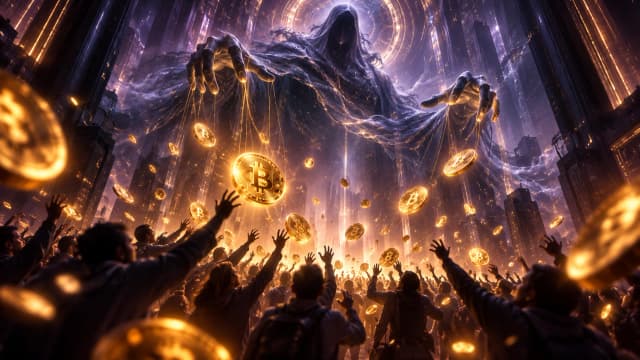 PredictionTrackingBITCOIN 2030WALL STREET PREDICTS $1.5 MILLION BITCOIN. THE REAL STORY: A TROJAN HORSE FOR FINANCIAL CONTROL.
 PredictionTrackingRAW MATERIALS 2030CRYPTO ROBBED THE PEOPLE. RAW MATERIALS PAY THEM BACK.
 PredictionTrackingQUANTUM COMPUTING 2030QUANTUM COMPUTING: THE $1 TRILLION DISRUPTION NOBODY IS PRICING.
Questions about BlackRock, answered
Who does Igor Beuker blame for the crypto damage?
I blame 2 groups: the scammers and the pirates. The scammers: Sam Bankman-Fried, Binance, the NFT sellers. Bankman-Fried's FTX lost about $8 billion of customer money. A jury convicted him on all 7 counts in November 2023, and he got 25 years in prison. Binance pleaded guilty in the US in November 2023 and agreed to pay $4.3 billion. Its founder, Changpeng Zhao, net worth about $110 billion, served 4 months in prison and was pardoned in October 2025. Then, in October 2026, Binance lost an estimated $6.3 billion in a hack, the biggest crypto theft on record. And the pirates: BlackRock's Bitcoin ETF, and the US, China, and the ECB taking turns killing it. The pirates did not steal coins. They took the story: money built to escape the banks now sits in a Wall Street fund. NFT.NYC, with 16,000 tickets at $1,000 and $16 million in the door, even refused to pay me as a speaker. Back the rails, not the clowns.
Full answer →Can stablecoins reshape government debt markets?
Yes, stablecoins can reshape government debt markets because their issuers park reserves in short-term US Treasuries, which quietly makes them major buyers of public debt. Tether alone holds more US Treasuries than South Korea, and Washington wrote that into law with the GENIUS Act in July 2025: every dollar stablecoin must be backed by dollars or Treasuries. Wall Street flipped. In 2017, BlackRock CEO Larry Fink, net worth about $1.4 billion, called Bitcoin an index of money laundering. In January 2024, BlackRock launched its own Bitcoin fund, now the world's biggest. In his 2025 letter to investors, Fink wrote that every stock, every bond, and every fund can be tokenized, also called fractional ownership: split into small digital shares that anyone can buy and trade. Stocks, real estate, and everything we know. First against it, now pushing all of it. I have mapped the scenarios: stablecoins take on America's debt, which passed $40 trillion in August 2026, as a new buyer of last resort, while policymakers, banks, and investors barely grasp what programmable money does at scale. The market is rewiring the plumbing of finance in public, and almost nobody reads the blueprint. I do. Follow the money, and you find it parked in Treasuries. Follow it further, and you find the off switch: the big issuers can freeze your coins. Stablecoins, digital dollars, USDT, USDC, tokenization, tokenized assets, fractional ownership and real-world assets: see my STABLECOINS 2030 prediction card.
Full answer →Why did Igor Beuker sell his Bitcoin in 2025?
Because I stopped believing the story. In March 2011, I bought $1,090 of Bitcoin, about 1,240 coins at $0.88 each. Then I watched the system move in: the first US Bitcoin funds on the stock market in January 2024, with BlackRock running the biggest one, and a US government Bitcoin reserve in March 2025. I believe Bitcoin is a psyop, a mind game run by the people in power. Decentralized money? Fantasy island. Governments and the global elite will never allow money they cannot control. So in July 2025, I sold at $105,000 a coin, over $100 million before tax, and turned my back on crypto and Bitcoin.
Full answer →What is the future of money?
The future of money is digital, programmable, and borderless. I predict blockchain, stablecoins, and digital payments rewire how value moves through the global economy. Cash and 3-day cross-border transfers give way to instant, programmable value, and the players are already in position: Visa and Mastercard settle in stablecoins, BlackRock sells Bitcoin in an ETF, and the ECB targets 2029 for the digital euro. I made the origin forecast on stage in 2008: the greedy masses go for crypto, the smart pick Bitcoin, the smartest back blockchain itself. I bought Bitcoin in March 2011 and cashed out in July 2025. The real question is no longer whether money goes digital. It is who writes the rules when it does. Watch the rule-writers, not the price charts. Digital money you do not control is a leash, not freedom.
Full answer →What is the future of blockchain?
The future of blockchain is infrastructure, not speculation. Blockchain is a shared record nobody can quietly edit, and I predict identity, payments, credentials, contracts, and supply chains will matter far more than short-term trading. I said it on stage in 2008: the greedy masses go for crypto, the smart pick Bitcoin, the smartest back blockchain itself. The hype phase hid the utility, and the crypto circus around it is the most fraudulent industry I have seen in 25 years: SBF, Binance, the NFT bubble. The lasting value is the shared record itself. But the middlemen did not disappear: JPMorgan, Visa, and BlackRock now run it under the hood. The circus fades. The infrastructure stays. Back the rails, not the clowns.
Full answer →What will the financial system look like in 2035?
By 2035 the financial system is far more digital, automated, and interconnected. I predict AI, blockchain, stablecoins, and digital identity rewire banking, payments, and global commerce. Settlement compresses toward instant: a payment that takes 3 days today clears in 3 seconds. The delay disappears. The middlemen do not: banks, funds and governments end up owning the rails, and whoever owns the rails decides who can pay. JPMorgan already runs its own blockchain for settlements, BlackRock tokenizes funds, and stablecoins move trillions a year. Institutions that adapt become infrastructure. Institutions that defend the old rails become history. Everyone wants innovation, nobody wants to change. Pick your side now.
Full answer →Is Bitcoin safe from quantum computing?
No, Bitcoin is not safe from quantum computing yet. Up to 35% of all Bitcoin sits in exposed addresses, Satoshi's 1.1 million coins included. Google's own estimate of what it takes to break Bitcoin's cryptography fell to under 500,000 qubits in March 2026. Q-Day, the day encryption breaks, lands 2030 to 2033 on aggressive estimates. BlackRock wrote quantum risk into its Bitcoin ETF filing while the influencers shouted number-go-up. The NSA set January 2027 as its quantum-safe deadline, NIST bans old encryption by 2035, the EU wants critical infrastructure safe by 2030.
Full answer →